
ChatGPT and Claude Ecosystems Explained
A practical enterprise map of ChatGPT, Claude, models, coding agents, APIs, tools, and the architecture behind AI workflows.
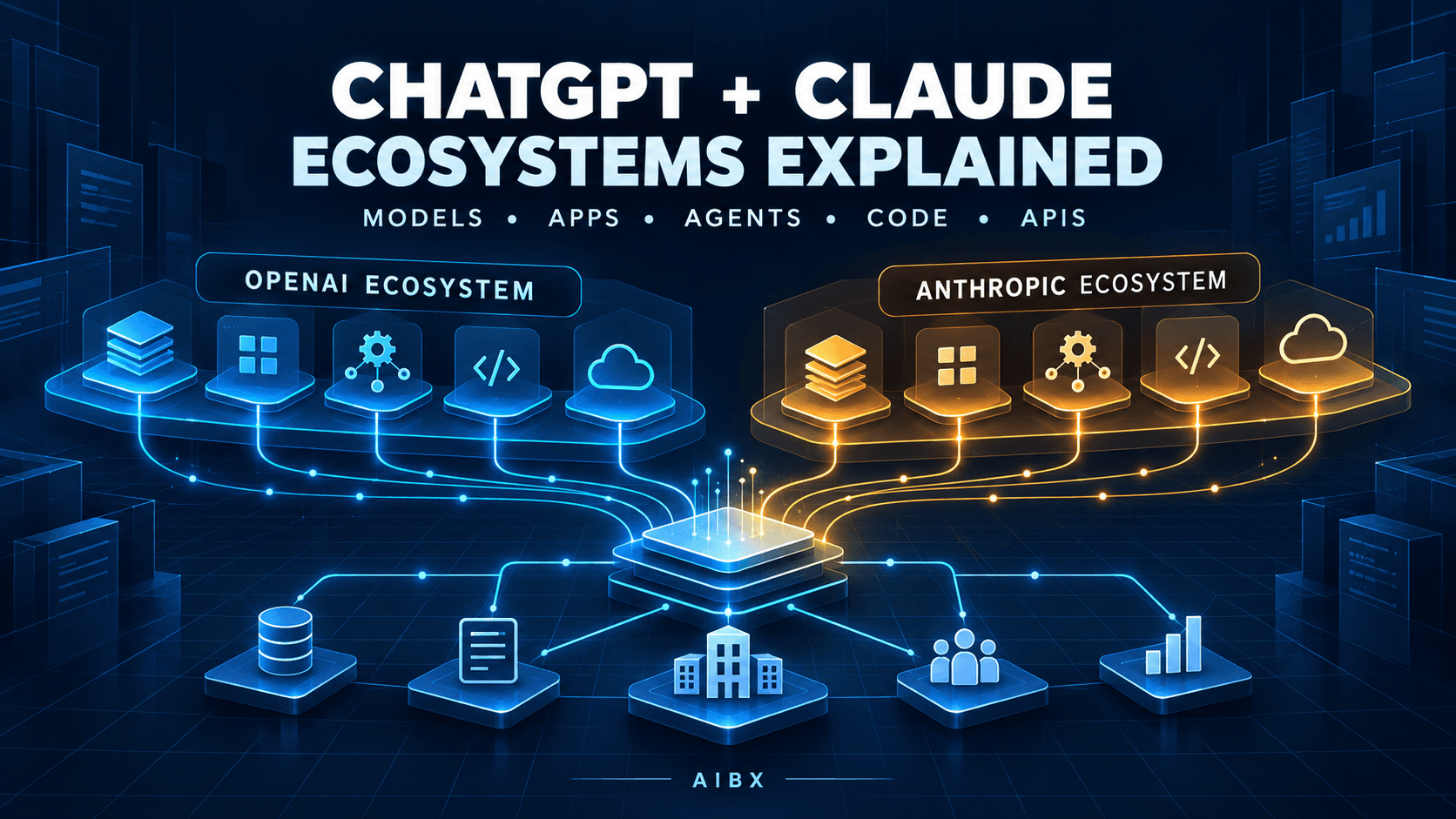
AIBX enterprise AI map · October 7, 2026
The useful question is not which product has the best name. It is where each layer belongs.
Product and model availability changes frequently. This guide reflects the OpenAI and Anthropic ecosystems as of October 7, 2026.
1
Models
2
Interfaces / agents
3
Tools / APIs
4
Enterprise workflows
Quick reference
Download the ChatGPT + Claude Enterprise AI Cheat Sheet
Keep the ecosystem map, architecture layers, and enterprise decision framework close at hand.
The mental model
The AI ecosystem in 60 seconds
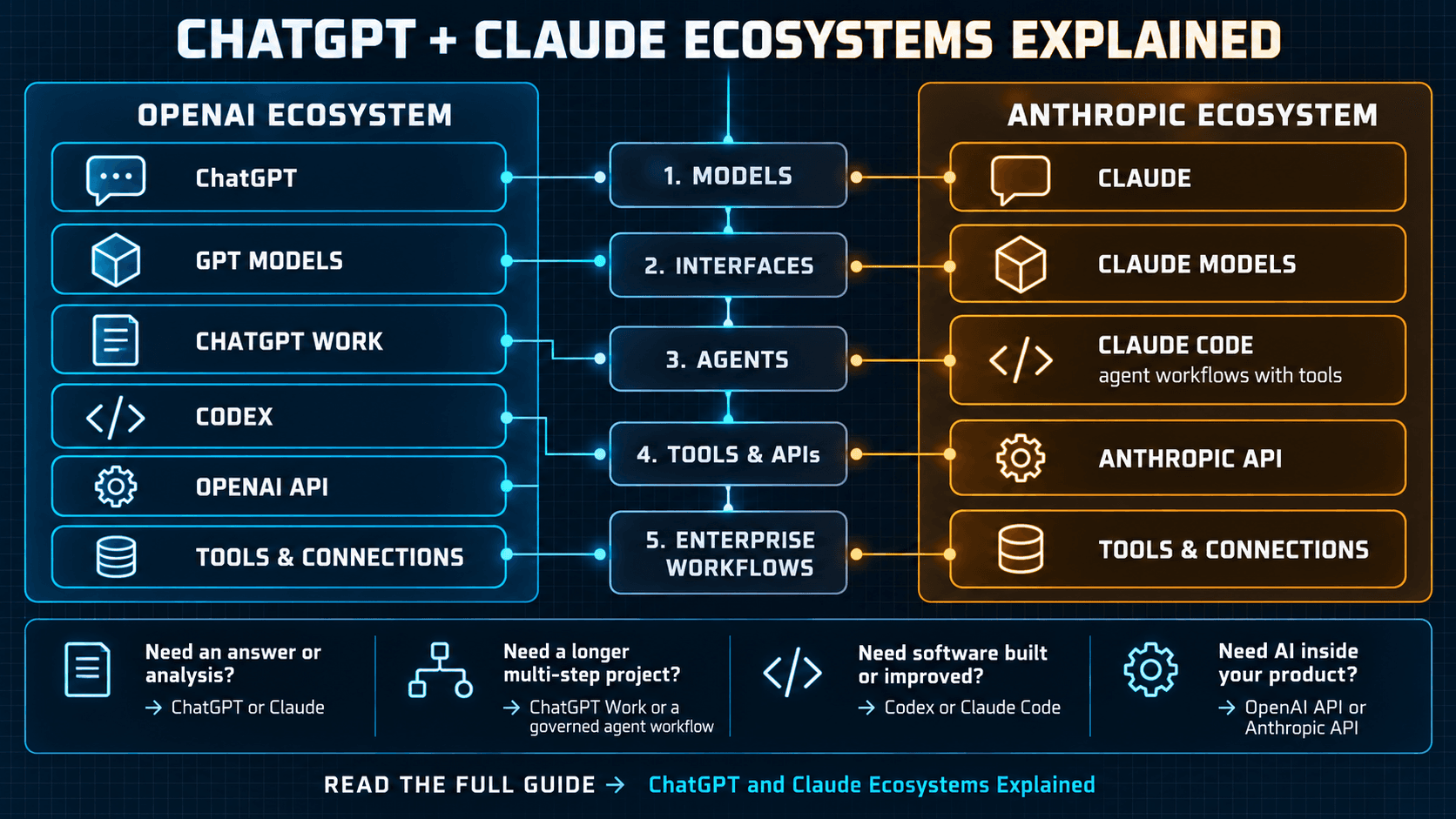
Models provide intelligence. Applications provide interfaces through which people access that intelligence. Agents combine models with instructions, tools, and environments to perform work. APIs let software call those capabilities programmatically. Connectors provide access to external applications, data, and organizational context. Enterprise workflows combine the layers into repeatable operating systems.
That distinction prevents a common architecture mistake: treating ChatGPT, GPT models, Codex, Claude, Claude Code, and their APIs as interchangeable products. They can share underlying capabilities, but they solve different operational problems.
OpenAI
The OpenAI ecosystem
OpenAI spans a consumer and enterprise application layer, model families, coding and execution surfaces, and APIs for developers. ChatGPT is the workspace people use directly. Codex is oriented toward delegated technical work, repository changes, tools, and environments. The API is the boundary for teams building their own software. The newer Agents API exposes a managed Codex harness for durable sessions, tools, sandboxes, and artifacts.
| Product / layer | What it is | Best for | Enterprise role |
|---|---|---|---|
| Models | General and specialized model families available through ChatGPT and the API. | Reasoning, generation, analysis, and task-specific workloads. | The intelligence layer; availability varies by surface. |
| ChatGPT | A user-facing AI workspace. | Knowledge work, research, writing, and collaboration. | An application with workspace, identity, and governance controls. |
| Codex | An agentic software and computer-work surface built around repository and tool execution. | Engineering, automation, and multi-step technical work. | A controlled execution layer, not simply another chat model. |
| OpenAI API | Programmatic access to models and tools. | AI features embedded in products and internal systems. | The integration boundary for software teams. |
| Agents API | A managed Codex harness for durable agent sessions, tools, environments, and artifacts. | Long-running applications that need orchestration. | A route to production agents with explicit environments and permissions. |
Current model families
OpenAI's current lineup includes GPT-5.6 Sol for demanding reasoning and coding, GPT-5.6 Terra for balanced work, and GPT-5.6 Luna for faster, lower-cost workloads. OpenAI also exposes newer GPT-6-class options in selected products and API contexts. Availability is surface- and account-dependent, so model names should be checked against the current product or API documentation before procurement.
OpenAI does not require an organization to choose one surface for every workload. A team may use ChatGPT for research and requirements, Codex for implementation, and the API for a customer-facing workflow. The tradeoff is that each surface introduces its own access, cost, monitoring, and governance questions.
Anthropic
The Anthropic ecosystem
Anthropic's ecosystem is organized around Claude as both an application experience and a family of models exposed through the Claude API and cloud platforms. Opus, Sonnet, and Haiku represent different capability, speed, and cost positions. Claude Code adds a developer-facing execution surface, while connectors and desktop extensions can give Claude access to remote services or local tools.
| Product / layer | What it is | Best for | Enterprise role |
|---|---|---|---|
| Claude | Anthropic's user-facing AI workspace and model family. | Analysis, writing, research, and knowledge work. | An application surface with team and enterprise controls. |
| Opus | The highest-capability Claude family for demanding reasoning and agentic work. | Complex analysis, difficult coding, and high-consequence tasks. | Use selectively where failure cost justifies additional capability. |
| Sonnet | A balanced Claude family focused on capability, speed, and cost. | General enterprise work, coding, and tool use. | Often the practical default for broad workloads. |
| Haiku | A faster, lower-cost Claude family. | High-volume classification, summaries, and responsive workflows. | Useful for routing, subagents, and latency-sensitive work. |
| Claude Code / API | Developer and programmatic surfaces for repository work and product integration. | Software engineering, tools, and embedded AI features. | The execution and integration layers; deployment choices affect control and governance. |
Current model families
As of October 7, 2026, Anthropic's current model family includes Opus 5.5 for demanding reasoning and agentic work, Sonnet 5.5 for balanced professional and coding workloads, and Haiku 5.5 for fast, high-volume, cost-sensitive tasks. Anthropic's official model lifecycle documentation should remain the authority for active, deprecated, and retired API model identifiers.
Anthropic's products do not need to mirror OpenAI's one-for-one. The useful comparison is architectural: which surface can safely perform the required work, under which identity, with which data, tools, and review gates? Current Anthropic documentation also makes the model lifecycle explicit: active, legacy, deprecated, and retired models should not be treated as equivalent deployment targets.
How the ecosystems differ architecturally
At the application level, ChatGPT and Claude are both general AI workspaces. At the model level, each provider maintains multiple capability and cost tiers. At the execution level, Codex and Claude Code are designed for software and tool-mediated work, but their environments, controls, and deployment paths differ. At the API level, both providers let teams embed models in software; the engineering surface is where identity, data access, retries, observability, and cost control become your responsibility.
The practical AIBX analysis is that the ecosystem is becoming a stack, not a single chatbot. Provider choice matters, but architecture matters more. The same model can be low-risk in a read-only research workflow and high-risk when connected to production systems with write access.
ChatGPT and Claude
The application-level comparison deserves its own treatment. ChatGPT and Claude can both support writing, analysis, research, and knowledge work, but the right choice depends on the tasks, tools, data boundaries, plans, and governance your organization needs. See AIBX's deeper Claude vs ChatGPT analysis for that separate question.
This hub intentionally avoids declaring a universal winner. A model that is excellent for a long document review may not be the best choice for low-latency classification or a coding workflow with strict repository controls.
Codex and Claude Code
Codex and Claude Code sit closer to the execution layer than a general chat workspace. They can work with repositories, files, commands, and development context, which makes the unit of value a completed task rather than a polished answer. The important questions are environment isolation, tool permissions, review workflow, and how clearly the system reports what it changed.
Use the AIBX Codex guide and Claude Code insights for product depth. This article only places both in the broader architecture.
App versus API: the enterprise decision
Choose an application when people need a ready workspace and the workflow benefits from human judgment. Choose an API when the capability belongs inside software, must run at volume, or needs integration with an existing identity and data model. Choose a coding agent when the work requires repository context and execution. Choose an agent workflow when the value comes from multiple steps, tools, and decisions across systems.
Applications reduce engineering effort but offer less control. APIs increase control and repeatability but require engineering, monitoring, cost management, and failure handling. Agents can increase productivity, but every new tool and permission expands the operational blast radius.
One AI vendor or several?
Standardization simplifies procurement, identity, training, support, security review, and governance. It can also make integrations and measurement more consistent. The tradeoff is dependency: a single provider may not be optimal for every workload, and its outages, pricing, product changes, or policy changes affect more of your operating model.
A multi-model architecture can improve workload specialization, resilience, and cost optimization. It also increases engineering complexity, evaluation requirements, observability, procurement overhead, and governance work. Add abstraction only where the operational benefit exceeds that complexity.
The governance layer
A model producing an answer is fundamentally different from an agent taking an action. The second case requires controls around identity, least privilege, data access, tool access, execution boundaries, approvals, logging, auditability, human review, and failure recovery.
Read
What data can this workflow inspect?
Decide
What may it infer or recommend?
Act
Which tools can it call, and with what permissions?
Recover
How is a failed or unsafe action stopped and reviewed?
Enterprise AI decision framework
| Requirement | Architecture | Why | Key tradeoff |
|---|---|---|---|
| General knowledge work | AI application | People need a ready workspace, files, research, and collaboration. | Less control than a custom application. |
| Complex research and analysis | Application with strong reasoning and approved tools | The workflow benefits from human steering and source review. | Longer tasks increase cost and review burden. |
| Software engineering | Coding agent | The system must inspect files, edit code, run commands, and verify output. | Execution access expands security risk. |
| High-volume automation | API workflow | The process is repeatable and measurable. | Engineering, monitoring, and failure handling are required. |
| AI inside internal software | API plus governed tools | The AI must operate inside an existing identity and data model. | Integration creates a permanent operational surface. |
| Cross-application work | Agent workflow with least-privilege connectors | The value comes from coordinated actions across systems. | Permissions, approvals, and auditability become central. |
| Sensitive-data workflow | Private, governed application or API architecture | Data boundaries and retention must be explicit. | Controls can reduce convenience and speed. |
What enterprises should do next
- Map current AI workloads by task, data sensitivity, user, and required action.
- Separate model selection from application and workflow selection.
- Identify which workflows genuinely require agents rather than a simple API call.
- Set permission boundaries and approval gates before enabling autonomous actions.
- Measure cost and failure rate at the workflow level, not only by token price.
- Avoid unnecessary vendor proliferation; add a second provider when the benefit is measurable.
- Establish observability before scaling long-running or cross-application agents.
Key takeaways
- Models, applications, agents, APIs, and workflows are different layers.
- ChatGPT and Claude are ecosystems, not single model names.
- Codex and Claude Code belong to the execution layer and require stronger controls.
- Standardization reduces governance overhead; multi-model systems increase flexibility but add complexity.
- Enterprise AI architecture should be chosen around work, permissions, and observability.
Related AIBX guides
Turn insight into workflow
Need help applying this inside real operations?
AIBX helps individuals and teams turn AI knowledge into governed workflows, reusable prompts, and practical implementation systems.
Related Articles
Continue Reading
ChatGPT
The Complete Guide to ChatGPT & Codex Models (2026)
A documentation-grade enterprise reference to the GPT-5.6 model family, reasoning effort, Codex, ChatGPT Work, Sites, Skills, and Scheduled Tasks, verified against official OpenAI sources.
Claude
Understanding Claude Models: Speed, Reasoning & Tokens
A systems-level breakdown of Claude models, including Haiku, Sonnet, Opus, token usage, context windows, latency, and reasoning tradeoffs.
Comparisons
Claude vs ChatGPT for Business | AIBX
A practical enterprise comparison of Claude and ChatGPT across writing, coding, reasoning, workflow automation, and business adoption.
AI Agents
AI Agents Explained for Business | AIBX
Learn how AI agents work, how they differ from chatbots, and how businesses use them for automation and operational workflows.