

Understanding Claude Models: Speed, Reasoning & Tokens
A systems-level breakdown of Claude models, including Haiku, Sonnet, Opus, token usage, context windows, latency, and reasoning tradeoffs.
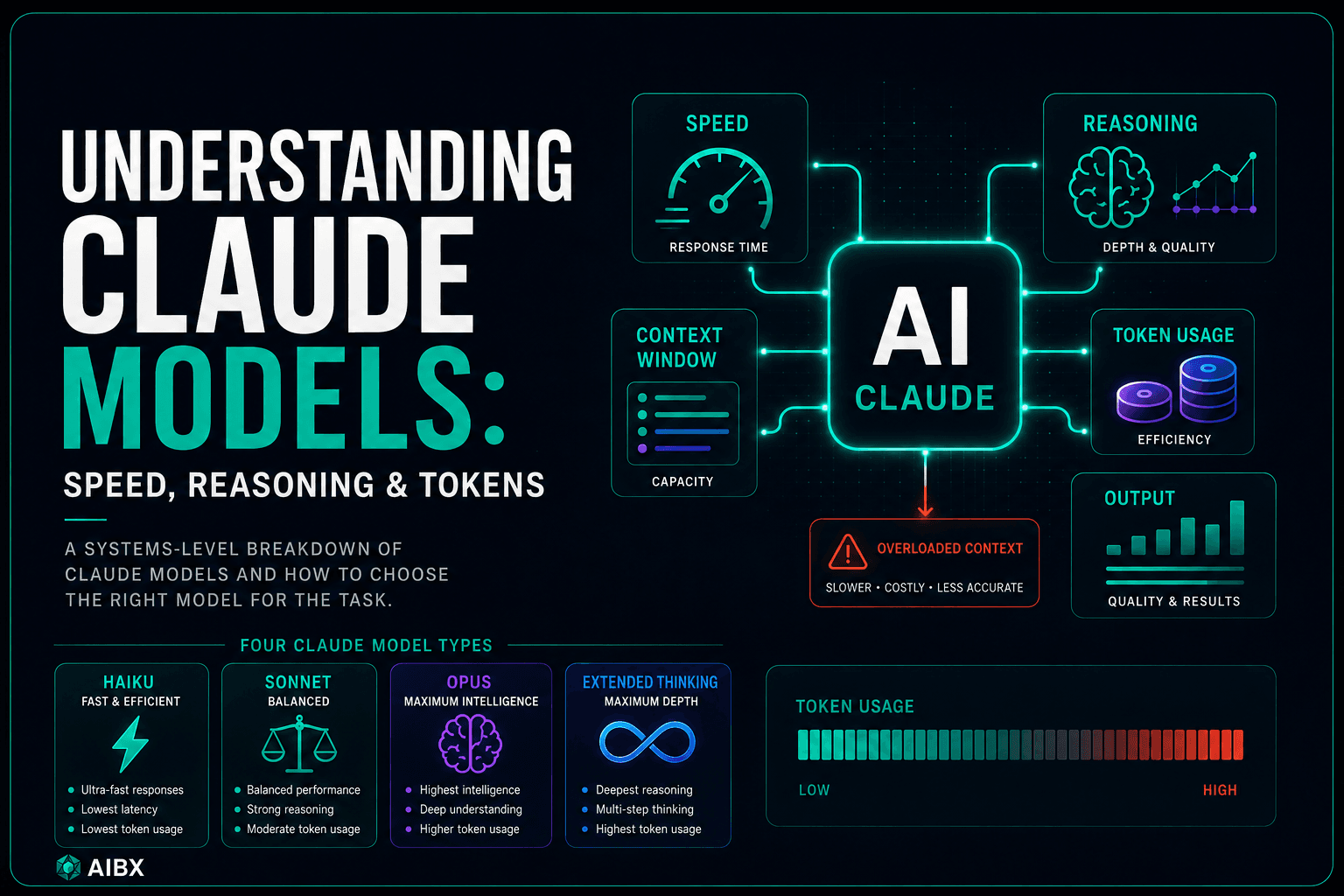
AI Systems Breakdown
Understanding Claude Models
Why Haiku, Sonnet, Opus, Fable, adaptive thinking, tokens, context windows, and reasoning depth matter more than most AI users realize.
Executive Summary
Claude is not one AI model.
Claude is a family of reasoning systems optimized around different tradeoffs: speed, latency, token usage, inference cost, and reasoning depth.
Understanding those tradeoffs changes how teams use AI operationally across workflows, coding, research, automation, and enterprise systems.
Core Idea
Different workloads require different AI systems.
Faster models reduce latency and compute usage. Larger reasoning systems increase analysis quality but require more processing.
The future of enterprise AI is increasingly moving toward multi-model orchestration instead of relying on one universal model.
Current as of October 14, 2026
Model names, availability, and pricing change frequently. This article reflects Anthropic's published model overview as of the date above. For active, legacy, and retired model identifiers, treat Anthropic's model documentation as the authority.
Claude Model Breakdown
Understanding the model ecosystem
Haiku
Fastest + lightweightBuilt for high-volume, latency-sensitive work such as classification, extraction, routing, summarization, and responsive subagents.
Sonnet
Speed + intelligenceAnthropic positions Sonnet as the best combination of speed and intelligence, well suited to everyday business workflows and coding at lower latency than Opus.
Opus
Agentic coding + knowledge workBuilt for long-running agentic coding and knowledge work, and Anthropic's suggested starting point for most workloads that need strong reasoning.
Fable
Deepest reasoningReserved for demanding reasoning and long-horizon agentic work, or for cases where evaluations on Opus at higher effort still fall short. It is the slowest and most expensive tier.
The Current Lineup
Four models, one shared baseline
All four current models accept text and image input, support tool use, and offer a 1M-token context window with up to 128K tokens of output. They differ mainly in latency, cost, and how much reasoning depth they bring to hard problems.
| Model | API ID | Latency | Best for |
|---|---|---|---|
| Claude Fable 5.1 | claude-fable-5-1 | Slower | Demanding reasoning, long-horizon agents |
| Claude Opus 5.5 | claude-opus-5-5 | Moderate | Long-running agentic coding, knowledge work |
| Claude Sonnet 5.5 | claude-sonnet-5-5 | Fast | Best mix of speed and intelligence |
| Claude Haiku 5.5 | claude-haiku-5-5 | Fastest | Classification, extraction, routing |
API availability is not the same as app availability. Which models appear in the Claude apps depends on your plan, so check the model picker in your own account, and use the API IDs above for API, Claude Code, and cloud-platform work. Older generations remain available as legacy models until their published retirement dates.
Adaptive Thinking and Effort
Reasoning depth is now a dial, not a mode.
Earlier Claude models offered "extended thinking" as a manual mode with a fixed thinking-token budget. On the current models, adaptive thinking lets Claude decide how much to think for each request, steered by an effort setting. Manual extended thinking is deprecated on some earlier models and is not accepted on the newest ones.
In practice, effort is the lever teams should manage: higher effort can improve results on hard problems but increases latency and token use, while lower effort keeps routine work fast and inexpensive. On the API, Opus and Haiku default to medium effort; Sonnet and Fable default to high.
Why Multiple Models Exist
AI inference is expensive.
Every AI response requires GPU computation, token processing, inference cycles, memory allocation, and active reasoning.
Larger reasoning systems usually consume more compute and increase latency. Smaller systems respond faster but may provide less reasoning depth.
Modern AI architecture is increasingly becoming a balancing act between speed, reasoning quality, operational efficiency, and compute cost.
Core Concepts
Understanding modern AI systems
Inference
Every AI response requires active GPU computation, token processing, memory allocation, and reasoning cycles.
Latency
Larger reasoning systems usually increase response time because the model performs more computation before returning an answer.
Context Windows
The context window acts as the active working memory available during inference.
Tokens
Every prompt, response, file, instruction, and conversation history consumes tokens inside the model context.
Context Windows
More context is not automatically better.
Current Claude models offer a 1M-token context window, but a larger window does not remove the cost of filling it. Long conversations increase token usage, reasoning complexity, latency, and the risk of conflicting instructions or degraded outputs.
This is why advanced users often restart conversations, compress context intentionally, and separate workflows into smaller focused sessions.
AI productivity is increasingly becoming a workflow architecture problem, not simply a prompting problem.
Operational Takeaways
Practical model selection guidance
Use Haiku when speed, volume, and low latency matter most.
Use Sonnet when you want strong capability at lower latency and cost than Opus.
Start with Opus for demanding coding and knowledge work, and move to Fable only when your own evaluations show it is needed.
Set thinking effort deliberately instead of defaulting everything to the highest level.
Start fresh conversations when context becomes overloaded.
Treat model selection as an operational workflow decision, and re-check it as the lineup changes.
Workflow Comparison
Old AI assumptions vs modern AI systems thinking
| One universal model | Multiple specialized models |
| Maximum speed | Balanced reasoning tradeoffs |
| Long overloaded chats | Focused context management |
| More context is always better | Context quality matters most |
| Single workflow approach | Multi-model orchestration |
| Prompt-only mindset | Systems-level AI understanding |
Final Thoughts
Understanding AI systems matters.
The future of enterprise AI is not just learning prompts. It is understanding inference, reasoning systems, latency, token usage, context management, and operational workflow architecture.
Turn insight into workflow
Need help applying this inside real operations?
AIBX helps individuals and teams turn AI knowledge into governed workflows, reusable prompts, and practical implementation systems.
Related Articles
Continue Reading
Workflows & Automation
Stop Burning Through Claude Tokens
Learn how structured workflows and prompt optimization improve Claude efficiency and reduce wasted token usage.
Comparisons & Buying Guides
Claude vs ChatGPT for Business | AIBX
A practical enterprise comparison of Claude and ChatGPT across writing, coding, reasoning, workflow automation, and business adoption.
AI Tools & Platforms
The Complete Guide to ChatGPT & Codex Models (2026)
A practical guide to GPT-5.6, reasoning effort, Codex, ChatGPT Work, Sites, Skills, and Scheduled Tasks for enterprise teams.
AI Tools & Platforms
ChatGPT and Claude Ecosystems Explained
A practical enterprise map of ChatGPT, Claude, models, coding agents, APIs, tools, and the architecture behind AI workflows.