
Claude vs ChatGPT for Business | AIBX
A practical enterprise comparison of Claude and ChatGPT across writing, coding, reasoning, workflow automation, and business adoption.
AI Platform Comparison
Claude vs ChatGPT: Which AI Platform Is Better for Business Workflows?
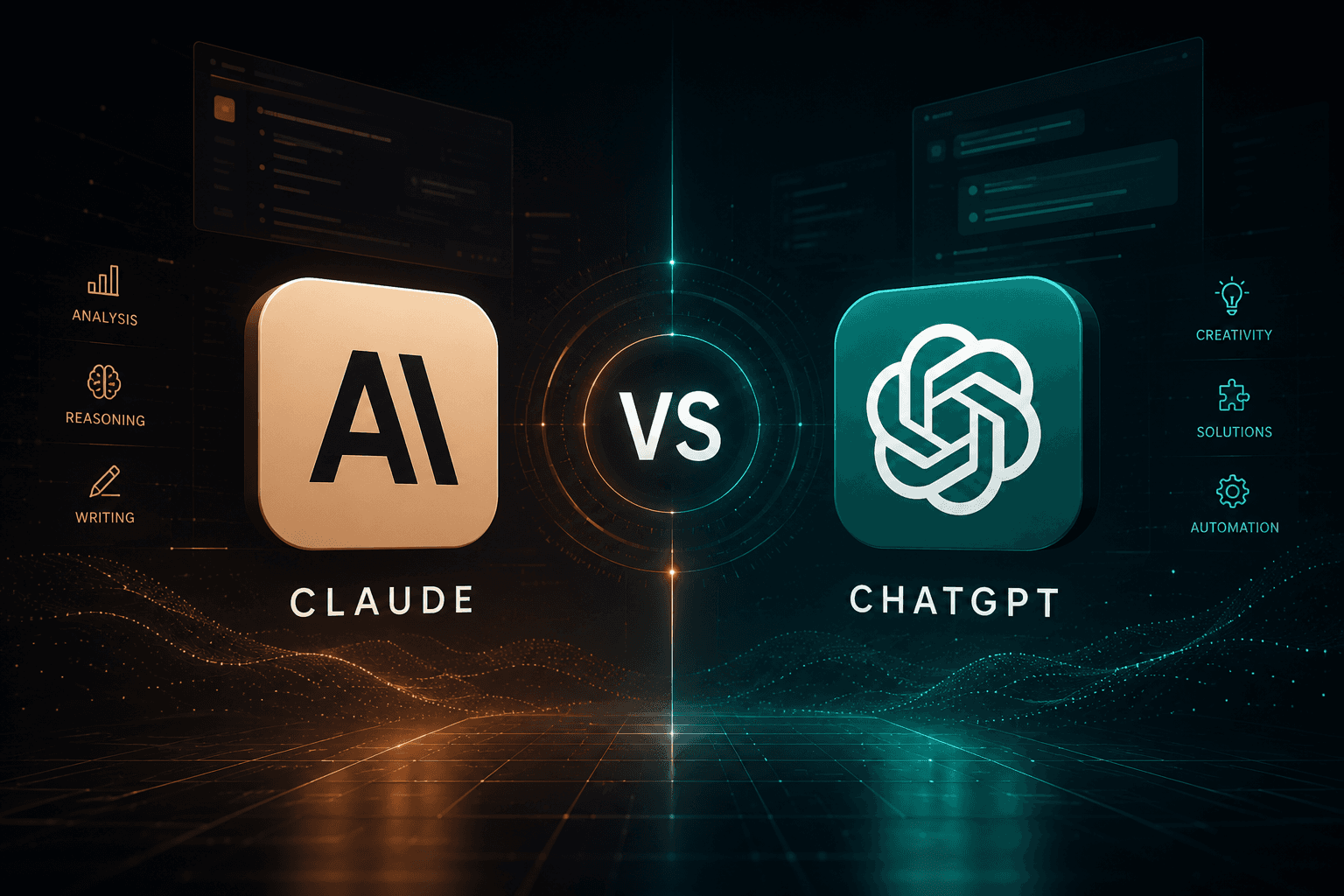
Claude and ChatGPT are two of the strongest AI platforms available to modern teams. Both can write, reason, summarize, code, analyze documents, and support business workflows. But they are not identical tools. For enterprise teams, the better choice depends less on generic model benchmarks and more on the work being redesigned.
Executive Summary
Claude is especially strong for careful writing, long-form reasoning, document-heavy work, and structured analysis. ChatGPT is especially strong as a broad AI workspace for business productivity, coding, data analysis, connected tools, custom assistants, and cross-functional adoption.
The practical answer is not simply “Claude or ChatGPT.” The better question is: which platform fits the workflow, the team, the data, the security model, and the level of operational integration required?
Claude vs ChatGPT at a Glance
| Area | Claude | ChatGPT |
|---|---|---|
| Best overall fit | Long-form analysis, structured reasoning, writing, research synthesis, and careful document-heavy work. | Broad business productivity, multimodal workflows, data analysis, custom GPTs, app integrations, coding, and general-purpose enterprise adoption. |
| Writing and analysis | Excellent for polished writing, nuanced tone, executive summaries, policy analysis, and document refinement. | Strong for practical drafting, brainstorming, rewriting, formatting, and turning ideas into usable business outputs. |
| Coding | Very strong for code reasoning, refactoring, architecture review, and Claude Code workflows. | Very strong for coding assistance, debugging, Codex workflows, code review, and app-connected development work. |
| Enterprise workflow | Strong fit for teams that need careful reasoning, knowledge work, document review, and structured outputs. | Strong fit for organizations that want broad adoption across departments, tools, data, automation, and custom GPT workflows. |
| Operational use | Best when accuracy, tone, document context, and reasoning quality matter more than tool ecosystem depth. | Best when teams need one flexible AI workspace that connects writing, research, data, coding, and automation. |
Where Claude Performs Best
Claude is often the better fit when the work requires nuance, structure, restraint, and careful reasoning. It is particularly useful for teams working with long documents, internal strategy, policy interpretation, research summaries, proposal language, and executive communication.
In practice, Claude feels less like a general productivity layer and more like a focused reasoning partner. That makes it valuable for teams that care about clarity, tone, and structured thinking.
Where ChatGPT Performs Best
ChatGPT is often the stronger choice when organizations want a broad AI workspace that can support many departments at once. It works well across writing, research, data analysis, coding, custom GPTs, app integrations, meeting workflows, documents, and general business productivity.
For many companies, ChatGPT’s biggest advantage is not a single isolated capability. It is the ability to become a shared operating layer across different business functions.
Business Use Cases
Practical Recommendations
Use Claude when the work is document-heavy
Claude is a strong fit for long-form analysis, executive writing, policy review, research synthesis, and complex reasoning across large bodies of text.
Use ChatGPT when the workflow spans many tools
ChatGPT is often the better fit when teams need broad productivity support across writing, data analysis, coding, custom GPTs, file workflows, and connected business apps.
Use both when AI becomes operational infrastructure
Many organizations should not treat this as a single-tool decision. Claude and ChatGPT can serve different roles inside the same AI operating model.
AIBX Recommendation
For most businesses, ChatGPT is the better starting point for broad AI adoption because it can support more everyday workflows across more teams. Claude becomes especially valuable when the organization needs deeper document reasoning, polished writing, careful synthesis, and high-quality strategic analysis.
The strongest enterprise AI strategy may use both: ChatGPT as the general productivity and workflow layer, and Claude as a specialized reasoning and document-analysis layer.
Final Verdict
Choose Claude if your team depends heavily on long-form writing, document review, careful reasoning, and polished communication. Choose ChatGPT if your team needs a flexible AI workspace for broad business productivity, coding, analysis, automation, and connected workflows. Choose both if AI is becoming part of your operating model rather than a single productivity experiment.
Turn insight into workflow
Need help applying this inside real operations?
AIBX helps individuals and teams turn AI knowledge into governed workflows, reusable prompts, and practical implementation systems.
Related Articles
Continue Reading
AI Tools & Platforms
Understanding Claude Models: Speed, Reasoning & Tokens
A systems-level breakdown of Claude models, including Haiku, Sonnet, Opus, token usage, context windows, latency, and reasoning tradeoffs.
Comparisons & Buying Guides
Top AI Chat Platforms in 2026
A strategic enterprise ranking of the top AI chat platforms in 2026 including ChatGPT, Gemini, Claude, Perplexity, Copilot, and emerging AI ecosystems.
AI Tools & Platforms
The Complete Guide to ChatGPT & Codex Models (2026)
A practical guide to GPT-5.6, reasoning effort, Codex, ChatGPT Work, Sites, Skills, and Scheduled Tasks for enterprise teams.
AI Tools & Platforms
ChatGPT and Claude Ecosystems Explained
A practical enterprise map of ChatGPT, Claude, models, coding agents, APIs, tools, and the architecture behind AI workflows.