AI Agents Explained for Business | AIBX
Learn how AI agents work, how they differ from chatbots, and how businesses use them for automation and operational workflows.
Executive Summary
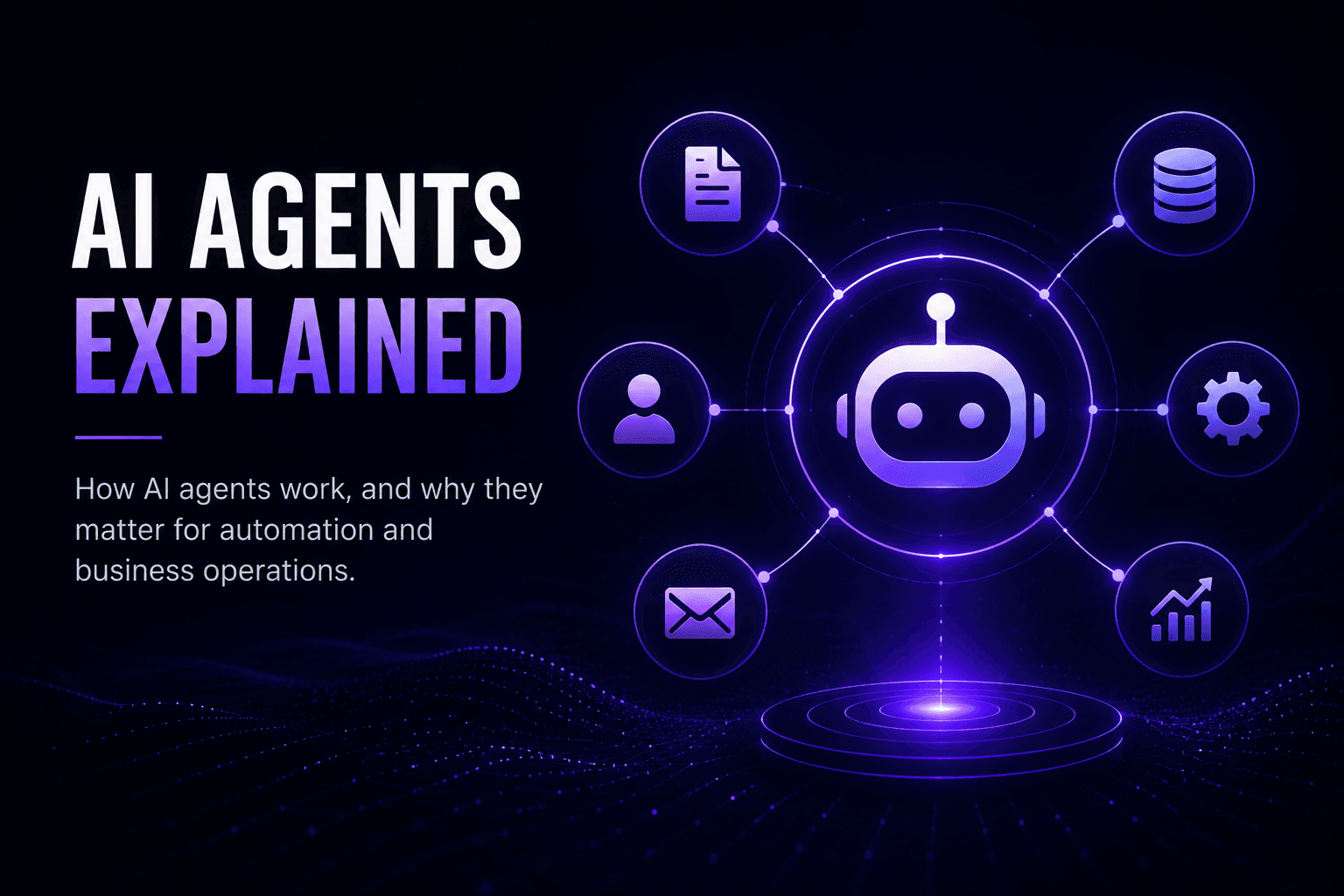
AI agents are systems that can work through a task using instructions, tools, context, and step-by-step reasoning. Unlike a basic chatbot, an agent is designed to move toward an outcome instead of only answering a message.
For businesses, the value of AI agents is not hype or autonomy for its own sake. The value comes from turning repetitive knowledge work into structured workflows that can be reviewed, improved, and scaled.
What Is an AI Agent?
An AI agent is an AI-powered system that can interpret a goal, decide on a sequence of steps, use available tools, and produce a result.
The key distinction is that an agent is not just a model — it is a workflow system combining reasoning, tools, and business rules.
Chatbots vs Assistants vs Agents
| System | Behavior |
|---|---|
| Basic chatbot | Responds to user prompts but usually does not take independent steps or use tools deeply. |
| AI assistant | Helps users complete work through conversation, files, analysis, and guided interaction. |
| AI agent | Plans steps, uses tools, follows instructions, checks progress, and works toward a defined outcome. |
| AI workflow system | Combines agents, automations, data sources, approvals, monitoring, and business rules into a repeatable operational process. |
Common Types of AI Agents
Task Agents
Agents that complete a specific task such as summarizing documents, drafting reports, researching a topic, or updating a record.
Workflow Agents
Agents that move through a multi-step business process using tools, files, rules, and decision logic.
Coding Agents
Agents that help plan, edit, test, debug, and review software projects across multiple files.
Research Agents
Agents that gather information, compare sources, synthesize findings, and produce structured outputs.
Operations Agents
Agents that support internal workflows such as ticket triage, CRM updates, reporting, onboarding, and knowledge base maintenance.
Enterprise Use Cases
How to Implement AI Agents Safely
Start with one narrow workflow
Define the agent’s role and boundaries
Connect only the tools it actually needs
Add human approval for sensitive actions
Log outputs and decisions
Measure time saved and error reduction
AIBX Recommendation
Start with narrow workflows instead of trying to build fully autonomous agents.
Focus on repeatable business processes where automation reduces friction, not judgment.
Turn insight into workflow
Need help applying this inside real operations?
AIBX helps individuals and teams turn AI knowledge into governed workflows, reusable prompts, and practical implementation systems.
Related Articles
Continue Reading
AI Tools & Platforms
Understanding Claude Models: Speed, Reasoning & Tokens
A systems-level breakdown of Claude models, including Haiku, Sonnet, Opus, token usage, context windows, latency, and reasoning tradeoffs.
Workflows & Automation
Stop Burning Through Claude Tokens
Learn how structured workflows and prompt optimization improve Claude efficiency and reduce wasted token usage.
AI Tools & Platforms
ChatGPT and Claude Ecosystems Explained
A practical enterprise map of ChatGPT, Claude, models, coding agents, APIs, tools, and the architecture behind AI workflows.
AI for Everyday Life
Use AI to Make Halloween Spookier at Home and Work
Use AI to plan a safer Halloween, create better activities, and reduce repetitive work without sharing sensitive personal or company data.