
What Is OpenAI Codex? | AIBX
See how OpenAI Codex works as an autonomous software engineering agent across CLI, IDE, cloud, and enterprise workflows.
Research Asset
Download the Codex Engineering Ecosystem PDF
This guide is available as an AIBX research-style PDF for teams evaluating AI coding agents, autonomous engineering workflows, and enterprise deployment strategy.
Download PDFVideo Breakdown
Watch the full OpenAI Codex engineering agent breakdown
Executive Summary
What Is OpenAI Codex?
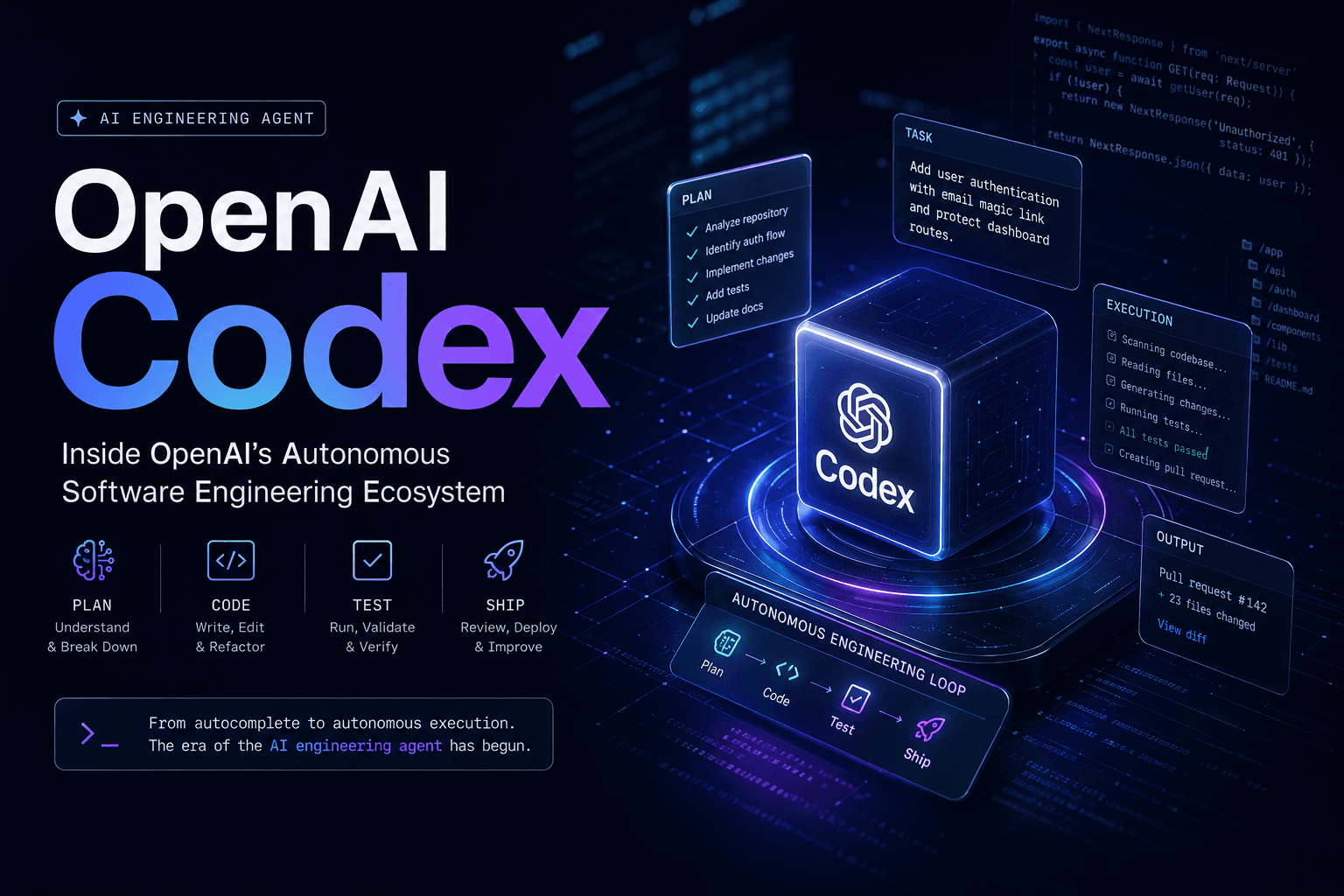
OpenAI Codex is an AI system designed to help with software engineering work. Earlier Codex was known mainly as a model that translated natural language into code. Modern Codex is better understood as an engineering agent: a system that can inspect a codebase, plan changes, edit files, run validation steps, and hand work back to a human reviewer.
That distinction matters. A basic coding assistant helps a developer write snippets. An engineering agent participates in the workflow around the code: implementation, testing, debugging, documentation, review, and iteration.
Codex Is Not Just AI Autocomplete
Autocomplete predicts the next line. Codex works closer to a delegated engineering workflow. A team can describe an outcome, give Codex access to the relevant project context, and ask it to produce a concrete change that can be reviewed.
The strategic value is not that Codex writes code faster in isolation. The value is that engineering tasks become more structured, observable, and repeatable. Developers shift from typing every implementation detail toward defining the task, reviewing the result, and improving the system around the work.
The Codex Workflow: Plan, Patch, Validate, Handoff
Plan
Codex interprets the task, reads the surrounding codebase, identifies likely files, and forms an implementation approach.
Patch
Codex applies targeted changes across one or more files while preserving the existing structure of the project.
Validate
Codex can run checks, inspect errors, revise the implementation, and prepare the work for human review.
Handoff
Codex summarizes what changed, what was tested, what risk remains, and what a reviewer should inspect next.
Codex vs ChatGPT
| Area | ChatGPT | Codex |
|---|---|---|
| Primary use | Conversation, explanation, planning, debugging, and flexible assistance | Delegated software engineering tasks across files, tools, tests, and repositories |
| Operating model | User-guided interaction | Agentic workflow execution |
| Best fit | Learning, analysis, brainstorming, documentation, and lightweight coding help | Implementation, refactoring, test repair, code review, and repository-aware work |
| Enterprise value | Improves individual productivity and technical reasoning | Turns engineering work into repeatable, reviewable delegated workflows |
Enterprise Use Cases
Security and Governance Still Matter
Codex should not be treated as an unchecked production engineer. Strong teams use it inside normal engineering controls: limited repository access, branch-based work, pull request review, automated tests, security scanning, dependency policies, and human approval for sensitive changes.
The goal is not blind autonomy. The goal is controlled delegation. Codex can reduce friction in the engineering process, but the organization still owns architecture, security, quality, compliance, and release accountability.
How Teams Should Adopt Codex
Start with narrow, reviewable tasks instead of full autonomy.
Keep humans responsible for architecture, security, approval, and production release decisions.
Use repository permissions, branch controls, pull requests, and test gates as the operating boundary.
Measure Codex by shipped workflow quality, not just lines of code generated.
The Future of Software Engineering Is Orchestration
Codex points toward a larger shift in software work. Developers will still need judgment, taste, architecture skill, and domain understanding. But more of the implementation loop can be delegated to systems that understand repositories, tools, and validation workflows.
In that environment, the most valuable engineering teams will not be the teams that simply generate the most code. They will be the teams that design the best systems for delegation, review, testing, and continuous improvement.
AIBX Recommendation
Treat Codex as part of an engineering operating system, not as a magic code generator. The strongest use cases are narrow, testable, reviewable workflows where human experts define the outcome and Codex accelerates the implementation loop.
AIBX helps teams evaluate AI coding tools, design safe agentic workflows, and operationalize AI systems across engineering, automation, and enterprise work.
Turn insight into workflow
Need help applying this inside real operations?
AIBX helps individuals and teams turn AI knowledge into governed workflows, reusable prompts, and practical implementation systems.
Related Articles
Continue Reading
AI Coding
Best AI Coding Tools for Developers and Engineering Teams
A practical enterprise guide to the best AI coding tools for software development, code review, debugging, refactoring, and agentic engineering workflows.
Workflows & Automation
AI Agents Explained for Business | AIBX
Learn how AI agents work, how they differ from chatbots, and how businesses use them for automation and operational workflows.
Comparisons & Buying Guides
Claude vs ChatGPT for Business | AIBX
A practical enterprise comparison of Claude and ChatGPT across writing, coding, reasoning, workflow automation, and business adoption.
AI Tools & Platforms
The Complete Guide to ChatGPT & Codex Models (2026)
A practical guide to GPT-5.6, reasoning effort, Codex, ChatGPT Work, Sites, Skills, and Scheduled Tasks for enterprise teams.