The Complete Technology Career Roadmap (2026) | AIBX
A 2026 technology career roadmap covering IT, cloud, DevOps, platform engineering, cybersecurity, data, AI operations, and certifications.
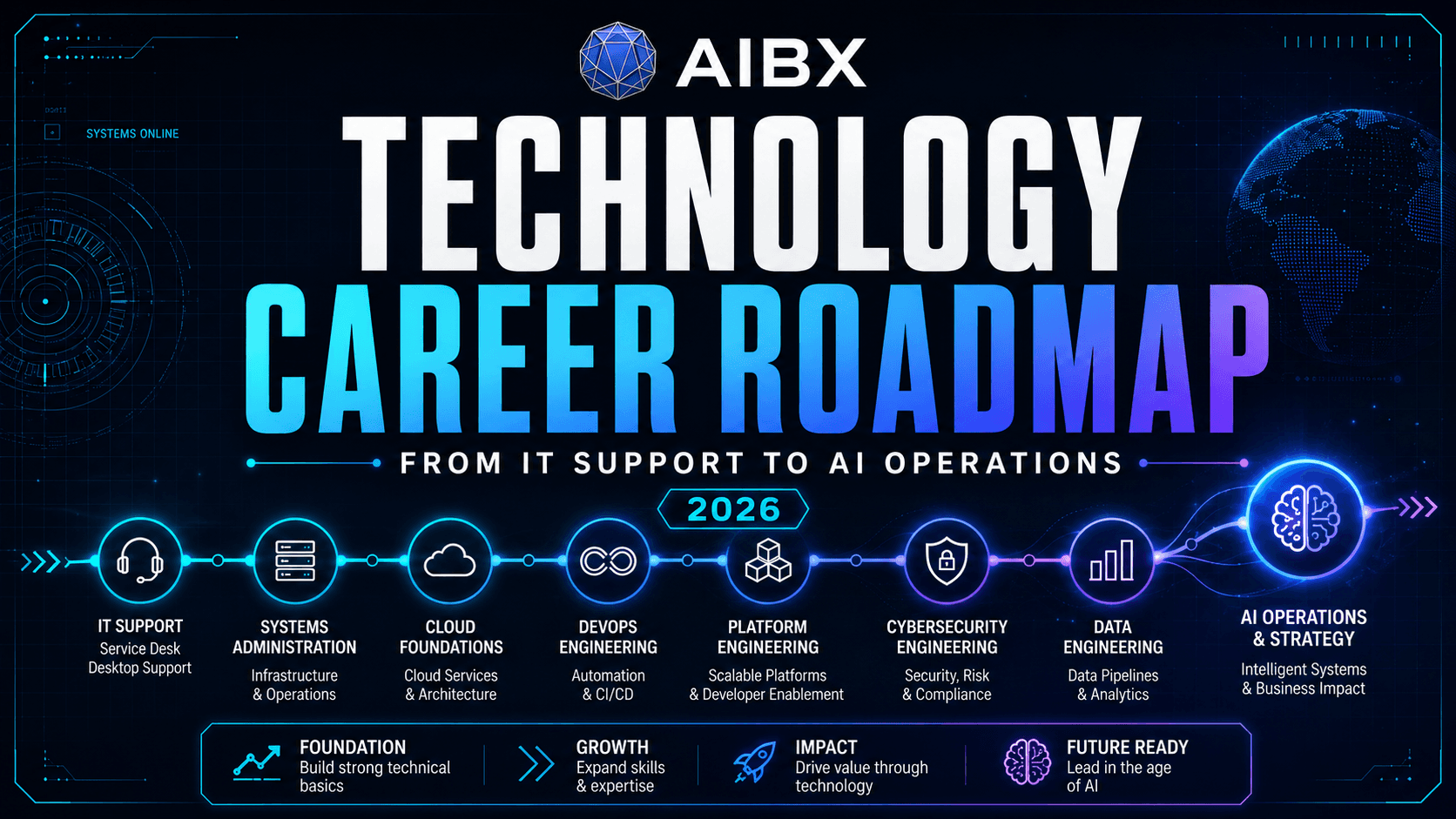
Understanding every IT, cloud, DevOps, security, platform engineering, and AI career path
In 2015, many companies still treated infrastructure, software delivery, and support as separate career tracks. By 2026, cloud engineering, DevOps, platform engineering, SRE, cybersecurity, and AI operations have turned technology careers into a much larger map.
This guide explains how the paths connect, where each role fits, and how to move from entry-level IT into high-value engineering and AI leadership roles.
Free Download
Technology Career Roadmap Cheat Sheet
Keep the 2026 role map, career ladders, certifications, and AI operations paths handy while you plan your next move.
Video Breakdown
Watch the technology career roadmap overview
Who This Guide Is For
Why Technology Careers in 2026 Are Different
The older career model was easier to explain: help desk, systems administration, network engineering, then IT management. That path still exists, but it no longer describes the full opportunity.
Cloud adoption, infrastructure as code, open-source platforms, DevOps, security integration, data infrastructure, and AI automation created specialized tracks with different tools, promotion patterns, and salary ceilings.
That split creates opportunity and confusion at the same time. Specialization can lead to premium roles, but only if you understand how the tracks connect and which skills compound across them.
How Modern Technology Organizations Are Structured
Reporting lines matter because they shape budget access, promotion paths, team influence, and the kind of problems a role is expected to solve. A modern organization often has a CTO or CIO above product engineering, infrastructure, platform, security, data, AI, and IT operations.
| Team | Typical Reporting Line | Career Implication |
|---|---|---|
| IT Operations | CIO, CTO, or Head of IT | Best for support, endpoint, identity, onboarding, internal systems, and practical business technology ownership. |
| Infrastructure Engineering | CTO, VP Engineering, or Director of Infrastructure | Best for systems, networking, cloud foundations, automation, storage, backup, and production operations. |
| Platform Engineering | VP Engineering or Director of Platform | Best for internal developer platforms, self-service delivery, guardrails, golden paths, and engineering productivity. |
| Security Engineering | CISO, CTO, or Head of Security | Best for risk, detection, IAM, cloud security, secure SDLC, incident response, and governance. |
| Data and Analytics | CDO, CTO, or VP Data | Best for data pipelines, warehouses, lakehouses, analytics platforms, AI-ready datasets, and business intelligence. |
| AI and Automation | CTO, CAIO, COO, or VP Engineering | Best for AI workflows, AI systems, model operations, evaluation, governance, and business process automation. |
The Core Technology Career Tracks
IT Support and Help Desk
The fastest entry point into technology for many people. Help desk is not a dead end; it is where you learn users, systems, identity, networks, and business urgency.
What the Role Does
Key Skills
Entry Path
Career Ladder
Certifications
Best Next Move
Systems Administration
Systems administration remains foundational even in cloud-heavy companies because every modern environment still depends on identity, servers, patching, monitoring, backups, and operational discipline.
What the Role Does
Key Skills
Entry Path
Career Ladder
Certifications
Best Next Move
Networking
Networking is the hidden foundation behind cloud, cybersecurity, remote work, reliability, and distributed systems.
What the Role Does
Key Skills
Entry Path
Career Ladder
Certifications
Best Next Move
Cloud Engineering
Cloud engineering is one of the strongest bridges from traditional infrastructure into platform engineering, AI systems, security, and architecture.
What the Role Does
Key Skills
Entry Path
Career Ladder
Certifications
Best Next Move
DevOps Engineering
DevOps is a delivery and operations discipline, not a single tool stack. The work is about making software delivery faster, safer, more observable, and more repeatable.
What the Role Does
Key Skills
Entry Path
Career Ladder
Certifications
Best Next Move
Platform Engineering
Platform engineering builds internal systems that make software delivery safer, faster, and more self-service for developers.
What the Role Does
Key Skills
Entry Path
Career Ladder
Certifications
Best Next Move
Site Reliability Engineering
SRE applies software engineering approaches to operations and reliability problems. It originated at Google in the early 2000s and is now widely adopted outside Google.
What the Role Does
Key Skills
Entry Path
Career Ladder
Certifications
Best Next Move
Cybersecurity
Cybersecurity is not one career. It includes SOC work, threat intelligence, cloud security, application security, IAM, GRC, DevSecOps, and security architecture.
What the Role Does
Key Skills
Entry Path
Career Ladder
Certifications
Best Next Move
Data Engineering
Data engineering bridges business data, analytics, automation, and production AI systems. Without reliable data pipelines, AI strategy becomes fragile.
What the Role Does
Key Skills
Entry Path
Career Ladder
Certifications
Best Next Move
The Rise of AI Operations
Many career roadmaps stop at cloud, DevOps, or cybersecurity. The next layer is AI operations: the intersection of automation, infrastructure, data, security, governance, observability, and enterprise workflow design.
Titles are still emerging and may vary by company. Focus on the responsibilities, skill stack, and transition path rather than treating every title as fixed.
AI Automation Engineer
- Owns
- Low-code, no-code, and API-connected AI workflows for business processes.
- Entry Path
- IT support, operations, business analysis, project management, support operations, RevOps, admin operations, or workflow automation.
- Required Skills
- Process mapping, prompt basics, APIs, webhooks, workflow design, data hygiene, testing, documentation, and change management.
- Tools
- Zapier, Make, n8n, Power Automate, Airtable, Notion, Google Workspace, Microsoft 365, OpenAI, Claude, and Gemini connectors.
- Career Ladder
- Automation Specialist -> AI Automation Engineer -> Senior AI Automation Engineer -> AI Workflow Lead -> Head of AI Automation.
AI Systems Engineer
- Owns
- Production AI workflows, RAG systems, multi-agent systems, AI APIs, and integrations.
- Entry Path
- Software engineering, DevOps, cloud architecture, data engineering, or advanced automation engineering.
- Required Skills
- Python or TypeScript, REST APIs, system design, LLM fundamentals, RAG architecture, vector databases, authentication, monitoring, and reliability.
- Tools
- OpenAI API, Claude API, Gemini API, LangChain, LlamaIndex, pgvector, Pinecone, Weaviate, Postgres, cloud functions, and queues.
- Career Ladder
- Software, DevOps, or Data Engineer -> AI Systems Engineer -> Senior AI Systems Engineer -> AI Engineering Lead -> VP AI Engineering.
AI Operations Engineer
- Owns
- Production AI reliability, governance, observability, cost controls, prompt/version management, and operational risk.
- Entry Path
- DevOps, SRE, cloud operations, security engineering, MLOps-adjacent work, or production operations.
- Required Skills
- Observability, incident management, cost optimization, security basics, auditability, MLOps concepts, vendor governance, and operational reporting.
- Tools
- LangSmith, Weights & Biases, Datadog LLM Observability, cloud monitoring, internal dashboards, prompt registries, and version registries.
- Career Ladder
- DevOps or SRE -> AI Operations Engineer -> Senior AI Operations Engineer -> Director of AI Operations.
AI Platform Engineer
- Owns
- Internal AI platforms, model-serving infrastructure, AI developer portals, evaluation frameworks, and shared AI infrastructure.
- Entry Path
- Platform engineering, infrastructure engineering, cloud architecture, or Kubernetes-heavy DevOps.
- Required Skills
- Kubernetes, MLOps, Python, APIs, platform engineering patterns, IAM, security, observability, and developer experience.
- Tools
- Kubernetes, Ray Serve, BentoML, MLflow, Backstage, Terraform, internal SDKs, model gateways, and evaluation systems.
- Career Ladder
- Platform Engineer -> AI Platform Engineer -> Senior AI Platform Engineer -> AI Platform Architect -> Head of AI Platform.
AI Solutions Architect
- Owns
- Enterprise AI systems, operating models, adoption roadmaps, governance models, vendor decisions, and implementation strategy.
- Entry Path
- Solutions architecture, cloud architecture, enterprise architecture, senior engineering, AI consulting, or technical leadership.
- Required Skills
- Stakeholder management, enterprise architecture, business process design, cloud and AI platform knowledge, security, governance, and ROI analysis.
- Tools
- Major LLM platforms, cloud AI services, workflow platforms, architecture frameworks, documentation systems, and governance tooling.
- Career Ladder
- Senior Engineer or Architect -> AI Solutions Architect -> Principal AI Architect -> VP AI Strategy -> CAIO or CDO in some organizations.
Which Career Path Should You Choose?
| If You Like | Start Here |
|---|---|
| I like troubleshooting people and systems | IT Support -> SysAdmin -> Infrastructure |
| I like infrastructure and architecture | SysAdmin -> Cloud Engineer -> Cloud Architect |
| I like automation and delivery | DevOps -> Platform Engineering -> AI Platform |
| I like uptime and incidents | SRE -> Principal SRE or Reliability Leadership |
| I like risk and defense | Security Analyst -> Security Engineer -> Security Architect |
| I like data and pipelines | Data Engineer -> Data Architect -> AI Systems |
| I like AI and workflows | AI Automation -> AI Systems -> AI Solutions Architecture |
| I like business strategy | Solutions Architecture -> Technology Leadership |
Real Career Journeys Are Rarely Linear
Help Desk -> SysAdmin -> Cloud Engineer -> DevOps Engineer -> Platform Engineer.
Help Desk -> Security Analyst -> Security Engineer -> Cloud Security Engineer -> Security Architect.
Business Analyst -> Automation Specialist -> AI Automation Engineer -> AI Systems Engineer -> AI Solutions Architect.
Developer -> DevOps Engineer -> SRE -> Principal SRE -> VP Engineering.
Data Analyst -> Data Engineer -> Data Architect -> AI Systems Engineer -> AI Platform Lead.
Salary, Remote Friendliness, and Time to Hire
These are directional U.S. market ranges, not guarantees. Traditional roles can be anchored to BLS occupational categories. Emerging AI roles require validation from current job postings and salary databases because BLS does not yet map them cleanly as separate occupational categories.
| Role | Typical U.S. Range | Remote Friendliness | Time to Hire From Zero |
|---|---|---|---|
| Help Desk / IT Support | $45k-$75k | High | 3-9 months |
| Systems Administrator | $70k-$110k | Medium | 12-24 months |
| Network Engineer | $80k-$130k | Medium | 12-30 months |
| Cloud Engineer | $95k-$155k | High | 12-30 months |
| DevOps Engineer | $110k-$175k | High | 18-36 months |
| Platform Engineer | $125k-$190k | High | 24-48 months |
| SRE | $125k-$200k | High | 24-48 months |
| Security Engineer | $105k-$180k | High | 18-42 months |
| Data Engineer | $105k-$175k | High | 18-36 months |
| AI Automation Engineer | $85k-$150k | High | 6-24 months |
| AI Systems Engineer | $130k-$220k | High | 24-48 months |
| AI Solutions Architect | $150k-$250k+ | High | 36-60 months |
Technology Career Progression Map
Tools That Reshaped the Last 5-8 Years
Backstage
Argo
Crossplane
n8n
LangChain
GitHub Copilot
Technology Certifications Quick Reference
| Track | Certifications to Consider |
|---|---|
| IT Support | CompTIA A+, ITIL Foundation, Microsoft MD-102 |
| Networking | Network+, CCNA, CCNP |
| Cloud | AWS Solutions Architect - Associate, Azure AZ-104, Google Associate Cloud Engineer |
| DevOps | CKA, CKAD, AWS DevOps Engineer - Professional, Terraform Associate |
| Security | Security+, CISSP, OSCP, AWS Security - Specialty |
| Data | Google Professional Data Engineer, AWS Certified Data Engineer - Associate, Databricks certifications |
| AI | AWS Machine Learning Engineer - Associate, Google Professional Machine Learning Engineer, vendor-neutral LLM and AI engineering certificates |
The Future of Technology Careers: 2027 and Beyond
Growing Roles
At-Risk Tasks
AI-Resistant Skills
The Practical Bet
Living Document Maintenance Plan
| Area | Review Rule |
|---|---|
| Salary ranges | Review every Q1 against BLS anchors, salary databases, and live job postings. |
| Certifications | Review when vendors update, rename, or retire exams. |
| Emerging roles | Add only when repeated job postings and credible hiring patterns support the role. |
| Tools | Update when tools show production adoption, CNCF maturity, enterprise funding, or strong ecosystem traction. |
Frequently Asked Questions
What is the best technology career path in 2026?
The best path depends on your strengths. Cloud, cybersecurity, DevOps, platform engineering, SRE, data engineering, and AI operations all have strong futures. For beginners, IT support to cloud or security remains one of the clearest paths.
What is the highest-paying IT career?
Senior cloud architects, principal SREs, platform architects, security architects, AI systems engineers, and AI solutions architects often sit near the top of the market, especially in enterprise and product engineering environments.
Is DevOps still a good career in 2026?
Yes. DevOps remains valuable, but the role is maturing. The strongest DevOps professionals understand cloud, CI/CD, containers, infrastructure as code, observability, security, and platform engineering.
What is the difference between DevOps and SRE?
DevOps emphasizes delivery, automation, and collaboration across development and operations. SRE emphasizes reliability engineering, measurable service health, SLOs, error budgets, incident response, and toil reduction.
What is the difference between platform engineering and DevOps?
DevOps often focuses on delivery workflows and operational automation. Platform engineering builds internal platforms, golden paths, templates, and guardrails so engineering teams can deliver software with less friction.
How long does it take to become a cloud engineer?
From zero, a realistic timeline is often 12 to 30 months depending on study intensity, prior IT experience, projects, certifications, and local hiring conditions.
Can you get into AI without a computer science degree?
Yes, especially through AI automation, operations, data, support operations, or business process roles. Production AI systems engineering usually requires stronger programming, API, cloud, and system design skills.
What certifications should beginners get first?
For general IT, start with CompTIA A+ or Network+. For cloud, choose one entry cloud path such as AWS Solutions Architect - Associate, Azure AZ-104, or Google Associate Cloud Engineer after learning fundamentals.
Is AI replacing IT jobs?
AI will reduce some repetitive ticket triage, basic scripting, manual reporting, and low-context monitoring work. It will increase demand for people who can design, govern, secure, monitor, and improve AI-enabled systems.
What is the fastest path from help desk to cloud engineering?
Build strong networking and Linux fundamentals, learn one cloud platform deeply, complete hands-on projects, document your work, earn a relevant cloud certification, and target junior cloud, support engineering, or infrastructure roles.
Turn insight into workflow
Need help applying this inside real operations?
AIBX helps individuals and teams turn AI knowledge into governed workflows, reusable prompts, and practical implementation systems.
Related Articles
Continue Reading
AI Coding
Learn Python for AI Automation | AIBX
Learn Python for AI automation, APIs, and workflow systems with beginner projects, examples, and a practical learning path.
AI Coding
How to Download, Install, and Use OpenAI Codex
Learn how to download, install, and use OpenAI Codex across desktop, CLI, IDE, web, and mobile workflows with beginner-safe setup steps.
Technology Systems & Infrastructure
What Is Docker? Beginner Guide | AIBX
Learn what Docker is, how containers work, and why it matters for AI workflows, development environments, and automation.
Technology Systems & Infrastructure
What Is Terraform? Infrastructure as Code Explained
Learn what Terraform is, how Infrastructure as Code works, and why it matters for DevOps and cloud automation.