Learn Python for AI Automation | AIBX
Learn Python for AI automation, APIs, and workflow systems with beginner projects, examples, and a practical learning path.
Executive Summary
Python has quietly become one of the operating layers of modern AI work. From automation pipelines and AI agents to data analysis, APIs, DevOps tooling, and machine learning infrastructure, Python sits near the center of serious AI workflows.
The good news is that you do not need a computer science degree to start building useful automation systems. You need a practical foundation, a few core patterns, and enough repetition to turn small scripts into reliable workflows.
Free Download
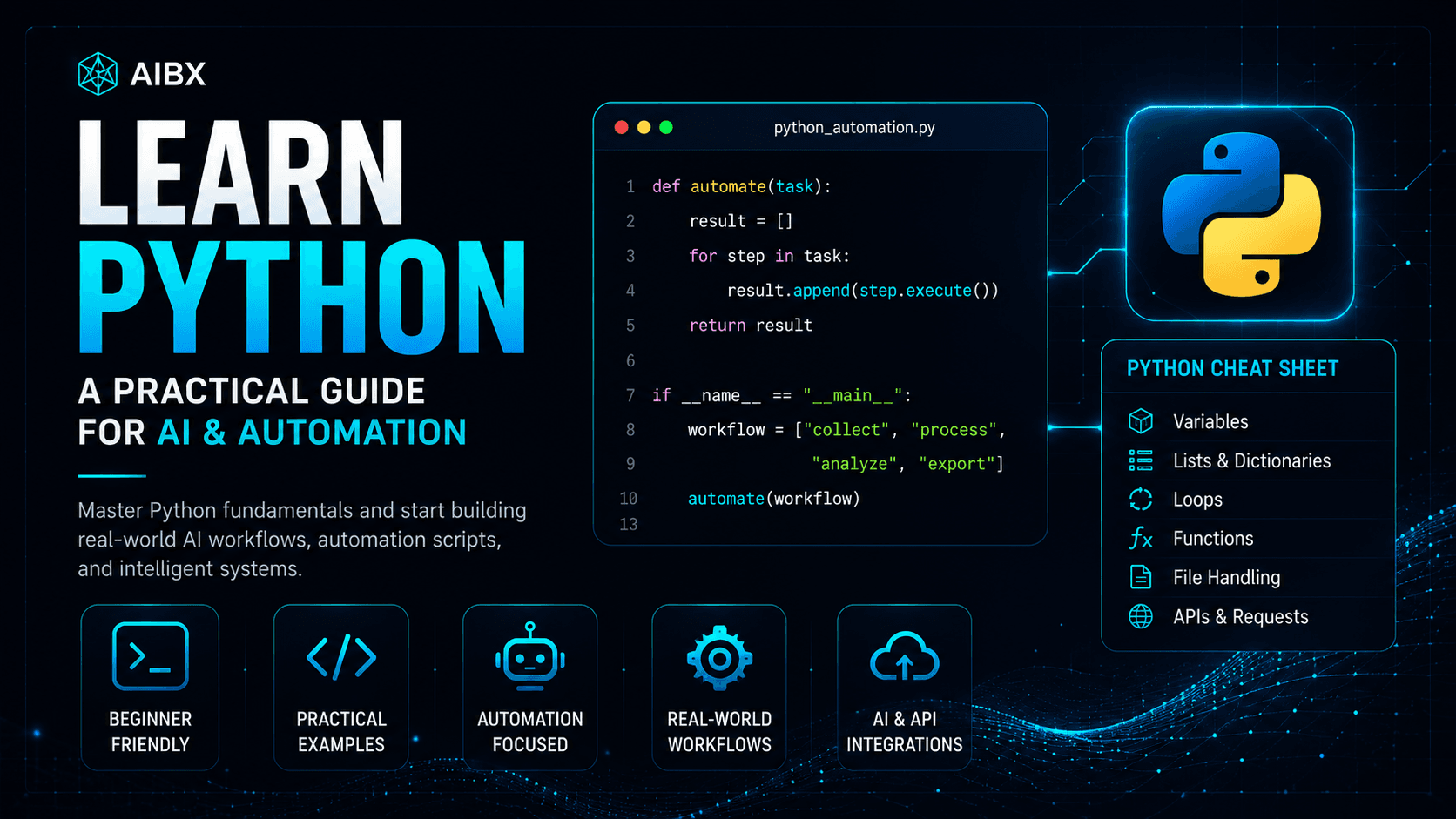
Python AI Automation Cheat Sheet
Keep the core Python concepts, automation patterns, and beginner syntax examples handy while you work through the guide.
Why Python Dominates AI
Python became the standard for AI and automation because it optimizes for readability, rapid development, ecosystem support, API integrations, automation tooling, and compatibility with major AI frameworks.
In enterprise environments, Python is often used for workflow automation, API orchestration, infrastructure scripting, AI agent pipelines, reporting systems, chatbot backends, DevOps tooling, and AI integrations.
What You Actually Need to Learn First
| Priority | Skill | Why It Matters |
|---|---|---|
| 1 | Variables | Store values your automation can reuse. |
| 2 | Functions | Package repeated logic into reusable steps. |
| 3 | Loops | Automate repetitive work across files, records, or API results. |
| 4 | Lists and dictionaries | Handle structured data from APIs, files, and AI tools. |
| 5 | APIs | Connect Python to AI models, SaaS tools, and workflow systems. |
| 6 | File handling | Read inputs, write reports, and maintain automation logs. |
| 7 | Error handling | Make scripts more reliable when real systems fail. |
Your First Python Script
Create a file called hello.py, add one line, and run it from your terminal. That tiny workflow contains the foundation of Python automation: create a file, write logic, execute the script, and inspect the result.
print("Hello, AIBX")Core Python Concepts
Variables
name = "AIBX"
age = 5
Lists
items = ["a", "b", "c"]Dictionaries
user = {
    "name": "Ara",
    "role": "Engineer"
}
Loops
for item in items:
    print(item)
Functions
def greet(name):
    print(name)
Error handling
try:
    print(10 / 0)
except ZeroDivisionError:
    print("Error")
Working With APIs
Modern AI systems rely heavily on APIs. APIs let Python communicate with AI models, cloud services, databases, workflow systems, SaaS platforms, and automation tools.
import requests

response = requests.get("https://api.github.com")

print(response.status_code)
Calling AI Models With Python
Once you understand basic scripts and API calls, you can start using Python to build AI copilots, automation agents, workflow assistants, research systems, and customer support tools.
from openai import OpenAI

client = OpenAI(api_key="YOUR_API_KEY")

response = client.chat.completions.create(
    model="gpt-4.1",
    messages=[
        {"role": "user", "content": "Explain AI agents"}
    ]
)

print(response.choices[0].message.content)
Beginner Project Ideas
AI research assistant that accepts a topic, summarizes findings, and exports notes.
Workflow automation that monitors folders, processes files, and sends notifications.
AI content pipeline that generates drafts, formats markdown, and prepares blog metadata.
API monitoring dashboard that tracks uptime, latency, failures, and automation health.
Common Python Libraries to Learn
requests
API calls
pandas
Data analysis
FastAPI
APIs and backend services
Flask
Lightweight web apps
openai
OpenAI model integrations
rich
Better terminal output
asyncio
Async automation
pathlib
File and folder management
Recommended Learning Path
Stage 1
Python basics
Variables, loops, functions, lists, and dictionaries
Write simple automation scripts.
Stage 2
Automation
File handling, APIs, scheduling, and JSON
Build practical workflow systems.
Stage 3
AI integrations
OpenAI SDKs, prompts, embeddings, and vector databases
Build AI-powered internal tools.
Stage 4
Production engineering
FastAPI, Docker, logging, async systems, and deployment
Build scalable AI automation platforms.
Enterprise Reality: What Actually Matters
In real-world enterprise environments, the best Python developers are not always the people with the most abstract programming knowledge. They are the people who can solve operational problems, automate repetitive workflows, reduce friction, improve reliability, and connect systems together.
That is where Python becomes extremely valuable. Build small systems repeatedly. Automate real problems. Ship practical workflows. Over time, those repetitions become real AI automation expertise.
Turn insight into workflow
Need help applying this inside real operations?
AIBX helps individuals and teams turn AI knowledge into governed workflows, reusable prompts, and practical implementation systems.
Related Articles
Continue Reading
AI Coding
Best AI Coding Tools for Developers and Engineering Teams
A practical enterprise guide to the best AI coding tools for software development, code review, debugging, refactoring, and agentic engineering workflows.
Workflows & Automation
AI Agents Explained for Business | AIBX
Learn how AI agents work, how they differ from chatbots, and how businesses use them for automation and operational workflows.
Comparisons & Buying Guides
Top AI Chat Platforms in 2026
A strategic enterprise ranking of the top AI chat platforms in 2026 including ChatGPT, Gemini, Claude, Perplexity, Copilot, and emerging AI ecosystems.
AI Coding
Claude Code /insights: Developer Workflow Analytics
Learn what Claude Code /insights is, how to read the report, and how enterprise teams can use it to improve AI-assisted development workflows.