

AI Careers in 2026: Jobs, Roles & Skills
Explore AI careers in 2026, including in-demand jobs, salaries, skills, career paths, and practical steps to start working in artificial intelligence.
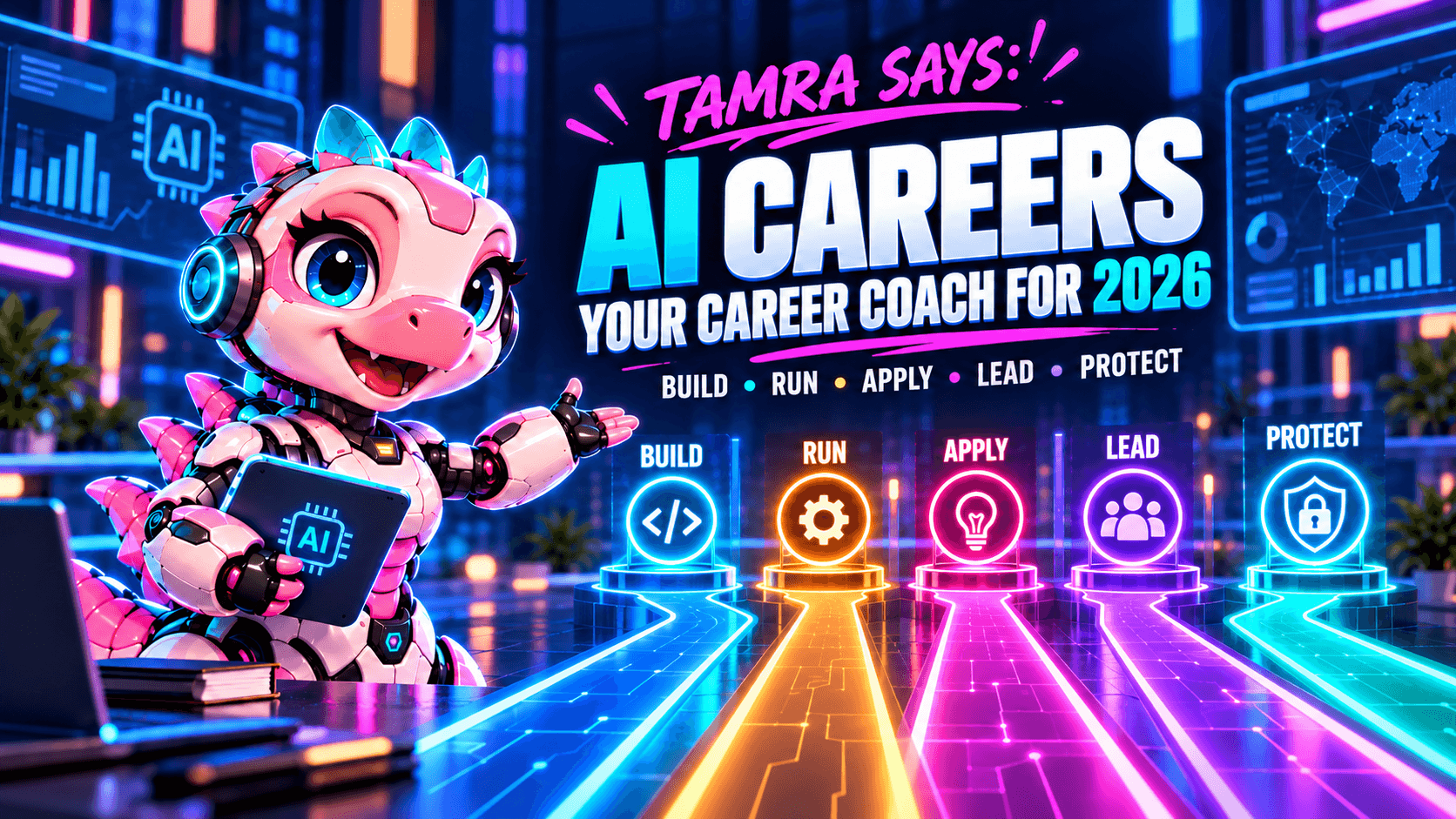
AIBX career field guide · Data reviewed October 20, 2026
AI is an industry, not a job title.
Artificial intelligence needs researchers, software engineers, data specialists, infrastructure operators, product leaders, workflow experts, security professionals, and governance teams. The right path depends on what you already know and what kind of problems you want to own.
How to use this guide
Follow three stages: Explore the industry and its families of work; Decide which direction fits your background; then Prepare evidence that you can contribute. No roadmap can guarantee employment, and a job title alone does not tell you the real requirements.
3-minute PDF cheat sheet
AI Career Families & Roles
A fast visual reference to the five career families, recognizable roles, career-fit pathways, and the 90-day starting plan.
Explore: what is the AI industry?
Most organizations sit in, or connect, three layers.
Build models
Research labs and model developers create foundation models, specialized models, training methods, safety techniques, and evaluation systems. These roles are usually the most research-intensive.
Build products
Product companies turn models into assistants, coding tools, agents, enterprise copilots, and business applications. AI engineering and product careers are concentrated here.
Adopt AI
Healthcare, finance, manufacturing, retail, logistics, government, and professional-services organizations apply AI to knowledge work, operations, customer service, documents, and decisions.
These layers overlap. A bank may build internal AI products; a model company may hire implementation specialists; a consultancy may operate systems for several clients. Enterprise adoption is why AI careers exist outside laboratories.
The five AI career families
Use the responsibility as your anchor. Titles vary across employers, and “AI agent engineer” is usually a specialization within Build or Apply—not a sixth family.
| Family | Representative titles | Primary responsibility | Coding | Entry difficulty |
|---|---|---|---|---|
| Build | AI / LLM engineer; ML engineer; research scientist; data scientist | Create models, applications, datasets, and evaluations | Core | Medium–Very high |
| Run | MLOps engineer; AI platform engineer; data engineer; SRE | Deploy, scale, monitor, and maintain AI systems | Core | Medium–High |
| Apply | AI automation specialist; evaluator; solutions engineer; AI UX designer | Adapt AI to workflows, products, and user needs | Optional–Helpful | Low–Medium |
| Lead | AI product manager; consultant; program lead; adoption manager | Choose use cases, define outcomes, and lead change | Optional | Medium–High |
| Protect | AI security specialist; privacy engineer; governance/risk specialist | Manage threats, controls, compliance, and responsible use | Optional–Core | Medium–High |
| Role | What the work looks like | Coding | Typical background |
|---|---|---|---|
| AI / LLM Engineer | Builds model-powered applications, agents, APIs, and evaluation loops | Core | Engineering or strong project evidence |
| Machine Learning Engineer | Trains, tunes, evaluates, and serves predictive or generative models | Core | Software, statistics, and ML experience |
| AI Research Scientist | Develops new methods and publishes or validates research | Core | Usually advanced degree or equivalent research record |
| Data Scientist | Uses statistical and computational methods to answer business questions | Core | Degree or equivalent analytical experience |
| MLOps / AI Infrastructure Engineer | Makes models reliable in production through deployment and observability | Core | Cloud, platform, or SRE background |
| Data Engineer for AI | Builds governed pipelines, storage, labeling, and data quality systems | Core | SQL, Python, and data-platform experience |
| AI Automation Specialist | Maps a process and connects AI tools with human review and controls | Helpful | Operations, APIs, and workflow evidence |
| AI Trainer / Evaluator | Tests outputs against rubrics and reports failure patterns | Optional | Domain judgment and careful documentation |
| AI Solutions / Sales Engineer | Translates customer requirements into safe technical solutions | Helpful | Technical communication and customer experience |
| AI UX / Conversation Designer | Designs understandable interactions, prompts, and recovery paths | Optional | UX, research, and content-design portfolio |
| AI Product Manager | Defines user problems, requirements, metrics, and launch decisions | Optional | Prior product ownership usually matters |
| AI Consultant | Assesses readiness, use cases, economics, and implementation risk | Helpful | Prior domain or consulting experience |
| AI Security Specialist | Threat-models models, tools, agents, identities, and data flows | Helpful–Core | Security engineering foundation |
| AI Governance / Risk Specialist | Creates policies, inventories, controls, and evidence | Optional | Risk, legal, audit, or compliance experience |
“Optional” coding does not mean easy. Product, governance, design, evaluator, and consulting roles still require judgment, domain credibility, communication, and often prior professional experience.
Where is demand strongest in 2026?
There are two different questions: which occupations mention AI skills, and which industries are investing or hiring. The evidence does not support one universal ranking of AI jobs.
Occupation demand
Current opportunity clusters around AI and ML engineering, data engineering, AI infrastructure/MLOps, application development, evaluation, automation, security, product delivery, and governance. Employers often advertise these under existing software, data, platform, risk, or operations titles.
Industry demand
Technology remains a major employer, but financial services, healthcare, manufacturing, cybersecurity, professional services, retail, logistics, and government are building adoption, integration, and oversight capabilities.
What the reports measure
BLS measures occupations and wages; Indeed measures job-posting language; Stanford’s AI Index tracks research, investment, adoption, and the economy; WEF reports employer expectations. These signals should not be substituted for one another.
Data as of
Reviewed October 20, 2026. WEF identifies AI and big data, networks and cybersecurity, and technological literacy among the fastest-growing skill areas through 2030. Indeed reports that jobs mentioning AI were growing even during broader hiring weakness. Stanford’s 2026 AI Index provides the wider market context.
Practical implication: search for the work, not just the phrase “AI job.” “Platform engineer,” “data engineer,” “security architect,” “implementation consultant,” and “product manager” may all include substantial AI responsibility.
Decide: pay, entry difficulty, and growth
Compensation depends heavily on geography, seniority, industry, employer, and total compensation. BLS does not publish a clean “AI engineer” occupation, so emerging-title salary claims should be treated cautiously.
| Career area | Salary evidence | How to interpret it |
|---|---|---|
| Data scientist | $83k–$194k (10th–90th percentile) | BLS median $120,230 in May 2025; 35% projected growth, 2025–35 |
| Software developer | Use the employer and geography range; title is broad | BLS median and outlook vary by developer category; AI work is not a separate BLS occupation |
| AI/ML engineer and emerging titles | No clean national BLS range | Compare posted base salary, level, location, and total compensation; do not treat title averages as guarantees |
| AI product, consulting, governance, and automation roles | No single reliable occupation-wide range | Compensation usually follows the underlying product, consulting, operations, risk, or engineering market |
For a comparable anchor, BLS reports a $120,230 median annual wage for data scientists in May 2025 and projects 35% employment growth from 2025 to 2035. That is useful occupational evidence, not a promise for every AI role. Equity, bonus, location, clearance, and scarce research expertise can move total compensation substantially.
Research scientist, senior ML engineer, AI security lead, product lead, consultant, and governance manager are generally not beginner roles. “No coding required” never means “no experience required.”
Skills, tools, and qualifications
Build
Python, SQL, APIs, statistics, ML fundamentals, LLM application architecture, retrieval, agents, evaluation, cloud, Docker, testing.
Run
Cloud platforms, data pipelines, deployment, observability, monitoring, reliability, cost controls, security, incident response.
Apply / Lead / Protect
Workflow mapping, requirements, process design, stakeholder communication, change management, threat modeling, privacy, audit, governance, and domain expertise.
Degrees matter most in research-intensive roles and can help with engineering or data roles, especially early in a career. They matter differently in implementation, product, operations, security, and governance. Certificates can demonstrate structured learning, but they do not substitute for a portfolio, professional history, or evidence that a system works.
A credible portfolio shows the problem, architecture, data boundaries, evaluation method, failure cases, cost, human-review design, and what changed because of the project.
Which path fits your background?
| Starting point | Potential directions | First evidence to build |
|---|---|---|
| Software developer | AI application, LLM, ML, or agent engineering | A tested API-based application with evaluation and error handling |
| IT / infrastructure | AI platform, MLOps, infrastructure, security, implementation | A deployed service with logging, access controls, and an architecture note |
| Business / operations | Automation, workflow implementation, AI operations, domain adoption | A measured workflow redesign with human review and exception handling |
| Data professional | Data engineering, ML, evaluation, analytics engineering | A documented pipeline or evaluation dataset with quality checks |
| Design / product | AI UX, conversation design, product, human-AI interaction | A prototype plus research, requirements, and failure-state documentation |
| Student / beginner | Foundations, entry-level data, evaluation, automation, internship | A small complete project and clear explanation of what you learned |
These are routes, not guarantees. A beginner may need to enter through software, data, operations, support, or an internship before specializing.
Prepare: your first 90 days
Days 1–30 · Learn
Choose one family. Learn its fundamentals, read real job descriptions, and reproduce one small example. Keep notes on tradeoffs and limits.
Days 31–60 · Build
Complete one practical project: an application, deployable service, workflow automation, implementation proposal, or AI risk assessment.
Days 61–90 · Demonstrate
Document the repository or case study, test failure modes, add a short demo, explain decisions, and ask someone credible for review.
Build
Learn Python, APIs, and LLM architecture. Build an API-based application. Demonstrate a repository, working demo, and evaluation results.
Run
Learn cloud, deployment, monitoring, and pipelines. Build a small deployable AI service. Demonstrate metrics, logs, and architecture decisions.
Apply
Learn workflow mapping, automation, limitations, and human review. Build a measurable automation. Demonstrate a process map, tests, and error handling.
Lead
Learn use-case evaluation, requirements, economics, and rollout risk. Build an implementation proposal. Demonstrate success metrics and feasibility—not executive mastery.
Protect
Learn threat modeling, privacy, and controls. Build a risk assessment. Demonstrate a risk register, mitigations, and validation checklist.
How to get hired in AI
- Search by function. Combine AI terms with engineering, data, platform, security, product, operations, or implementation.
- Read requirements literally. Separate must-have experience from preferred tools and identify the business outcome behind the role.
- Show measurable work. Explain latency, accuracy, cost, adoption, cycle time, quality, risk reduction, or review burden.
- Use your existing domain. A healthcare operator, finance analyst, designer, or security engineer can bring context that a generic project cannot.
- Consider internal moves. An AI pilot, automation project, data initiative, or governance working group can create evidence before a title change.
- Prepare for the interview type. Engineering interviews test systems and code; implementation interviews test discovery and tradeoffs; governance interviews test controls and judgment.
Networking works best when you can discuss a real problem and a small body of work. Communities, internships, apprenticeships, professional associations, and internal mentors can all help—but none replace capability evidence.
A realistic career roadmap
Most careers compound through adjacent work: software → AI application engineering; data → ML or evaluation; cloud → MLOps; operations → automation; security → AI security; product → AI product management. The transition is often a sequence of credible projects, not a single course or title.
For a broader technology progression, read AIBX’s technology career roadmap. For practical foundations, explore Python for AI automation, then review how AI agents work and the infrastructure foundations in Docker and Terraform. Use AIBX Learn for structured learning resources.
Frequently asked questions
Can I work in AI without coding?
Yes, some AI UX, evaluation, governance, product, consulting, and workflow roles use little or no programming. They still require domain skill, judgment, and often prior experience.
Are AI jobs only at model companies?
No. Companies adopting AI need people who can integrate, operate, secure, evaluate, govern, and improve AI-enabled workflows.
Is prompt engineering a standalone career?
Sometimes it appears as a task or narrow title, but prompt design is more durable when combined with engineering, evaluation, UX, content, or domain expertise.
Will a certificate get me an AI job?
A certificate can structure learning and signal interest. It is rarely enough for advanced roles without a portfolio or relevant professional evidence.
What is the best AI career for beginners?
There is no universal answer. Start with adjacent entry points—software, data, operations, support, evaluation, or internships—and build from demonstrated work.
Conclusion: choose a direction, then create evidence
AI careers span Build, Run, Apply, Lead, and Protect. Demand is distributed across model companies, product companies, and organizations adopting AI. Pay is real but uneven; titles are inconsistent; and the strongest candidates connect technical or domain skill to a measurable outcome.
Your next move is simple: choose one family, study five real job descriptions, build one small project, document its limits, and ask for informed feedback. That will not make you an AI expert in 90 days. It will give you something more useful at the start: a tested direction and evidence for the next step.
Sources and methodology
Labor-market and compensation context was reviewed October 20, 2026 using the U.S. Bureau of Labor Statistics data scientist outlook, the Stanford 2026 AI Index, Indeed Hiring Lab’s January 2026 AI-posting update, and the World Economic Forum Future of Jobs Report 2025. BLS figures describe broad occupations; Indeed and WEF measure different labor-market signals; Stanford provides ecosystem context. None should be read as a ranking of every AI title.
Turn insight into workflow
Need help applying this inside real operations?
AIBX helps individuals and teams turn AI knowledge into governed workflows, reusable prompts, and practical implementation systems.
Related Articles
Continue Reading
Technology Careers & Learning
The Complete Technology Career Roadmap (2026) | AIBX
A 2026 technology career roadmap covering IT, cloud, DevOps, platform engineering, cybersecurity, data, AI operations, and certifications.
AI Coding
Learn Python for AI Automation | AIBX
Learn Python for AI automation, APIs, and workflow systems with beginner projects, examples, and a practical learning path.
Workflows & Automation
AI Agents Explained for Business | AIBX
Learn how AI agents work, how they differ from chatbots, and how businesses use them for automation and operational workflows.
Technology Systems & Infrastructure
What Is Docker? Beginner Guide | AIBX
Learn what Docker is, how containers work, and why it matters for AI workflows, development environments, and automation.