
ChatGPT Plans and Models 2026: Browser & Codex Access
A practical AIBX guide to ChatGPT plans, browser reasoning modes, Codex models, usage economics, and choosing the right setup for real work.
AIBX field guide · Latest information as of September 10, 2026
The right ChatGPT setup depends on the work you need to do.
ChatGPT is no longer one model behind one chat box. Plans determine access and capacity; the browser and Codex are different work surfaces; and model choice changes the balance between speed, quality, and usage.
4
chapters in this guide
2
work surfaces to compare
1
practical rule: use the least expensive model that works reliably
Before you compare models
Why plan and surface come first
A model name by itself does not tell you what a user can do. Access varies by plan, account, workspace permissions, product surface, and rollout status. A Plus user may see one model picker in browser ChatGPT and a different set of choices in Codex. A business user may have the same underlying models with very different controls around data, billing, and administration.
Disclaimer
This guide reflects the latest information available as of today, September 10, 2026. Models, features, usage limits, availability, and pricing are subject to change. Confirm the current OpenAI pricing page and the model options shown in your own account before making a purchase or deployment decision.
01 · Plans and pricing
Choose the capacity and controls your work needs
Individual plans are mostly about access and capacity. Business and Enterprise plans add a second layer: workspace governance, company context, administration, and procurement requirements.
Individual plans
| Plan | Price | Best for | What changes |
|---|---|---|---|
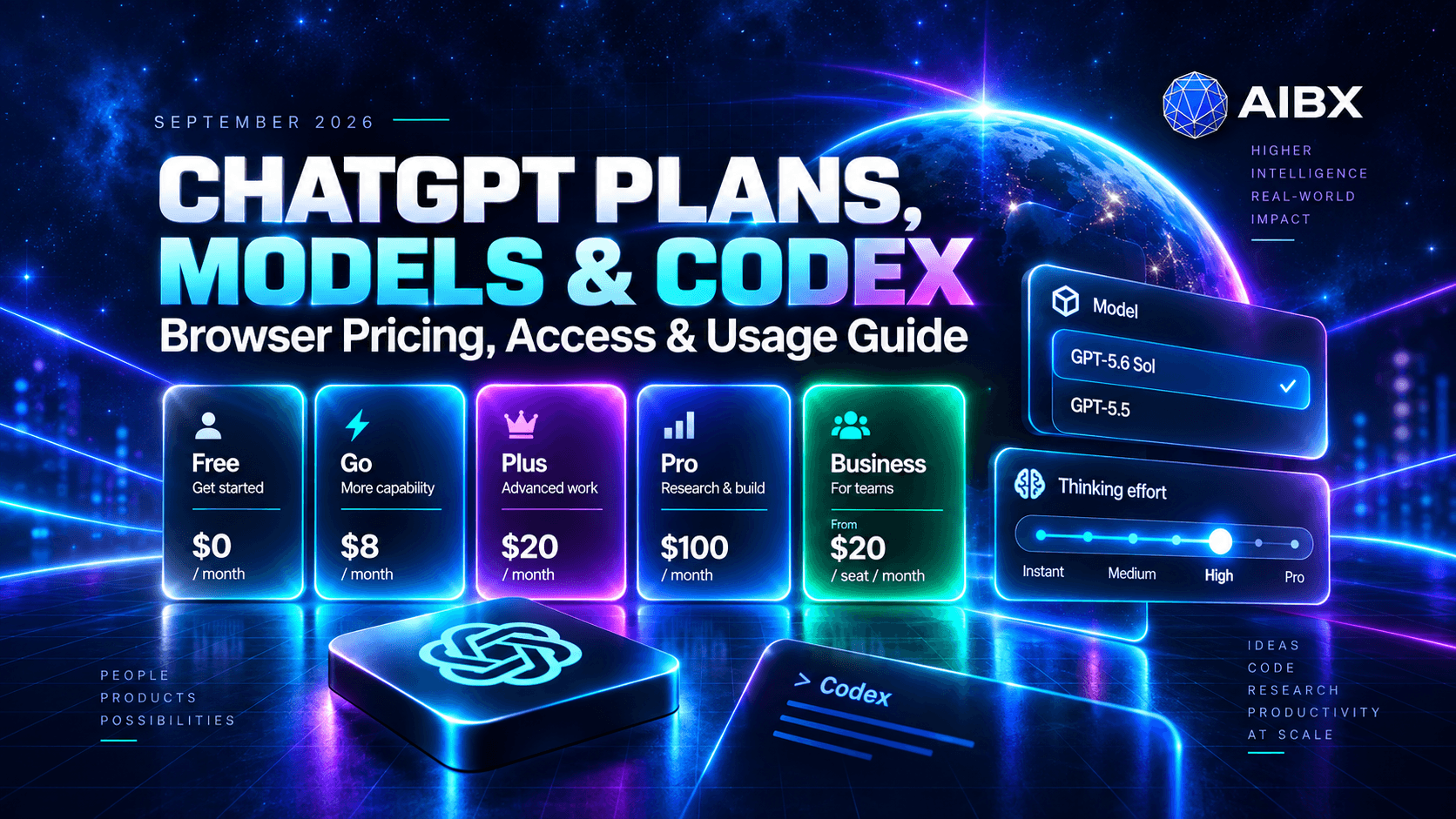
| Free | $0/mo | Try ChatGPT | GPT-5.6 Luna; limited uploads, research, memory, and Codex |
| Go | $8/mo | Longer everyday use | More messages, uploads, images, voice, and memory |
| Plus | $20/mo | Professional productivity | Advanced reasoning, projects, research, custom GPTs, and expanded Codex |
| Pro | From $100/mo | Heavy research and coding | Higher usage, Pro reasoning, maximum Codex and research capacity |
Free and Go
Free is useful for trying the product and light everyday work. Go adds room for longer conversations, uploads, images, voice, and memory without positioning itself as the full advanced-reasoning tier.
Plus and Pro
Plus is the practical professional default. Pro becomes easier to justify when high usage, deep research, long context, or frequent Codex work makes Plus limits restrictive.
Business and Enterprise
| Plan | Price | Best for | What changes |
|---|---|---|---|
| Business Standard | $20 annual / $25 monthly | Managed team work | Secure workspace, connectors, administration, and included ChatGPT/Codex access |
| Business Premium | $100 annual / $125 monthly | High-usage teams | 5x more usage than Standard and no five-hour limit |
| Enterprise | Custom | Governance at scale | Security controls, data residency, support commitments, custom terms, and volume pricing |
The business decision is not simply “which model is smartest?” It is whether your organization needs centralized billing, SSO and MFA, connectors, usage analytics, spend controls, workspace agents, data protections, data residency, support commitments, and custom terms.
AIBX take
For most serious individual professionals, Plus is the strongest balance of capability and cost. Business is the more meaningful upgrade when the problem is team governance rather than personal model access.
02 · Browser models
Browser ChatGPT is a reasoning workspace
The browser is optimized for writing, research, planning, analysis, and general professional work. In the current paid experience, GPT-5.6 Sol is the main advanced model, GPT-5.5 may remain available for comparison or compatibility, and the reasoning control determines how much effort the system spends on the response.
Thinking effort is not the same as switching models
| Setting | Role | Good for | Practical read |
|---|---|---|---|
| Instant | Speed | Quick answers, rewrites, summaries | Fastest response |
| Medium | Everyday reasoning | Planning, writing, analysis | Best default for most professionals |
| High | Deep reasoning | Strategy, architecture, difficult comparisons | Use when quality matters more than speed |
| Pro | Pro model access | Hard research and complex workflows | Requires eligible Pro access |
Instant, Medium, and High are effort choices attached to the browser experience. They are not three unrelated models. Pro is different because it represents access to a higher Pro model tier where the account is eligible.
Fast
Instant
Use for routine questions, rewrites, summaries, and quick decisions.
Default
Medium
The sensible starting point for business writing, planning, and analysis.
Deep
High
Reserve for technical planning, strategy, and difficult comparisons.
A browser decision rule
Start with Medium for serious work. Move to High when the task has more dependencies, tradeoffs, or consequences than a quick response can handle. Use Instant when the cost of waiting is higher than the value of extra reasoning.
03 · Codex models and usage
Codex is the implementation surface
Codex is built for repository work: inspecting files, changing code, running commands, testing, debugging, and completing multi-step engineering tasks. That changes the model decision. The question is no longer only “which answer sounds best?” It is “which model can complete this task reliably at an acceptable cost?”
| Model | Position | Best suited for | Credits: input / cached / output per 1M |
|---|---|---|---|
| GPT-5.6 Luna | Fast and economical | Small edits, renames, repetitive work | 5 / 0.5 / 30 |
| GPT-5.6 Terra | Balanced workhorse | Features, APIs, tests, routine refactors | 50 / 5 / 300 |
| GPT-5.6 Sol | Flagship reasoning | Architecture, migrations, difficult debugging | 100 / 10 / 500 |
| GPT-6 Astra | Frontier option | High-risk, high-complexity engineering | 250 / 25 / 1,250 |
Codex input cost
Credits per 1M input tokens
The rate card makes the tradeoff visible. Luna is dramatically cheaper for lightweight work; Terra is the balanced default; Sol is worth the extra usage when repository context and failure cost rise; Astra belongs at the top of the escalation path. Credit usage is based on actual input, cached input, and output tokens, so a long-running agent task can cost much more than a short prompt suggests.
A simple selection ladder
Luna
Tiny, repetitive, low-risk edits.
Terra
Normal feature and API work.
Sol
Multi-file reasoning and hard bugs.
Astra
High-risk, frontier engineering.
The operational rule is simple: use the least expensive model that can complete the task reliably. A cheap model that needs three retries and extensive human repair is not cheaper in practice. A powerful model used for a one-line rename is wasteful.
04 · Recommendation
A practical setup for different kinds of work
Browser ChatGPT and Codex are complementary. The browser is where teams define problems, research options, write requirements, and communicate decisions. Codex is where developers inspect the repository, implement changes, run checks, and iterate.
| Scenario | Plan | Browser | Codex |
|---|---|---|---|
| Basic personal use | Free or Go | Available default | Limited Codex |
| Professional individual | Plus | Sol · Medium | Terra |
| Research-heavy work | Plus or Pro | Sol · High / Pro | Sol |
| Everyday development | Plus | Sol · Medium | Terra |
| Complex engineering | Plus or Pro | Sol · High | Sol or Astra |
| Managed team deployment | Business | Workspace controls | Terra / Sol |
AIBX workflow
Define
Browser research and requirements
Implement
Codex repository work
Verify
Tests, review, and escalation
Our recommendation
For most professionals, Plus is the sensible starting point. Use GPT-5.6 Sol at Medium in browser ChatGPT for normal work, raise the effort when the problem demands it, and start Codex tasks with Terra. Keep Luna for high-volume, low-risk changes. Escalate to Sol when the codebase, debugging depth, or cost of failure makes stronger reasoning worthwhile. Consider Pro, Business Premium, or Enterprise when usage, governance, or support needs—not curiosity—justify the extra cost.
The best AI workflow is not built around always choosing the strongest model. It is built around matching the surface, plan, model, and effort to the work in front of you.
Frequently asked questions
Is Pro automatically the best plan?
No. Pro is valuable when usage volume, deeper reasoning, long-running research, or frequent Codex work exceeds what Plus comfortably supports.
Should every coding task use Sol or Astra?
No. Start with Luna or Terra when the task is small or routine, then escalate when the task reveals broader reasoning or higher failure risk.
Are browser and Codex usage the same?
They are related but not identical. Limits, credits, model availability, and task accounting depend on the feature, plan, workspace, and model used.
Turn insight into workflow
Need help applying this inside real operations?
AIBX helps individuals and teams turn AI knowledge into governed workflows, reusable prompts, and practical implementation systems.
Related Articles
Continue Reading
AI Tools & Platforms
The Complete Guide to ChatGPT & Codex Models (2026)
A practical guide to GPT-5.6, reasoning effort, Codex, ChatGPT Work, Sites, Skills, and Scheduled Tasks for enterprise teams.
AI Coding
Best AI Coding Tools for Developers and Engineering Teams
A practical enterprise guide to the best AI coding tools for software development, code review, debugging, refactoring, and agentic engineering workflows.
AI Coding
What Is OpenAI Codex? | AIBX
See how OpenAI Codex works as an autonomous software engineering agent across CLI, IDE, cloud, and enterprise workflows.
Comparisons & Buying Guides
Top AI Chat Platforms in 2026
A strategic enterprise ranking of the top AI chat platforms in 2026 including ChatGPT, Gemini, Claude, Perplexity, Copilot, and emerging AI ecosystems.